
 Login


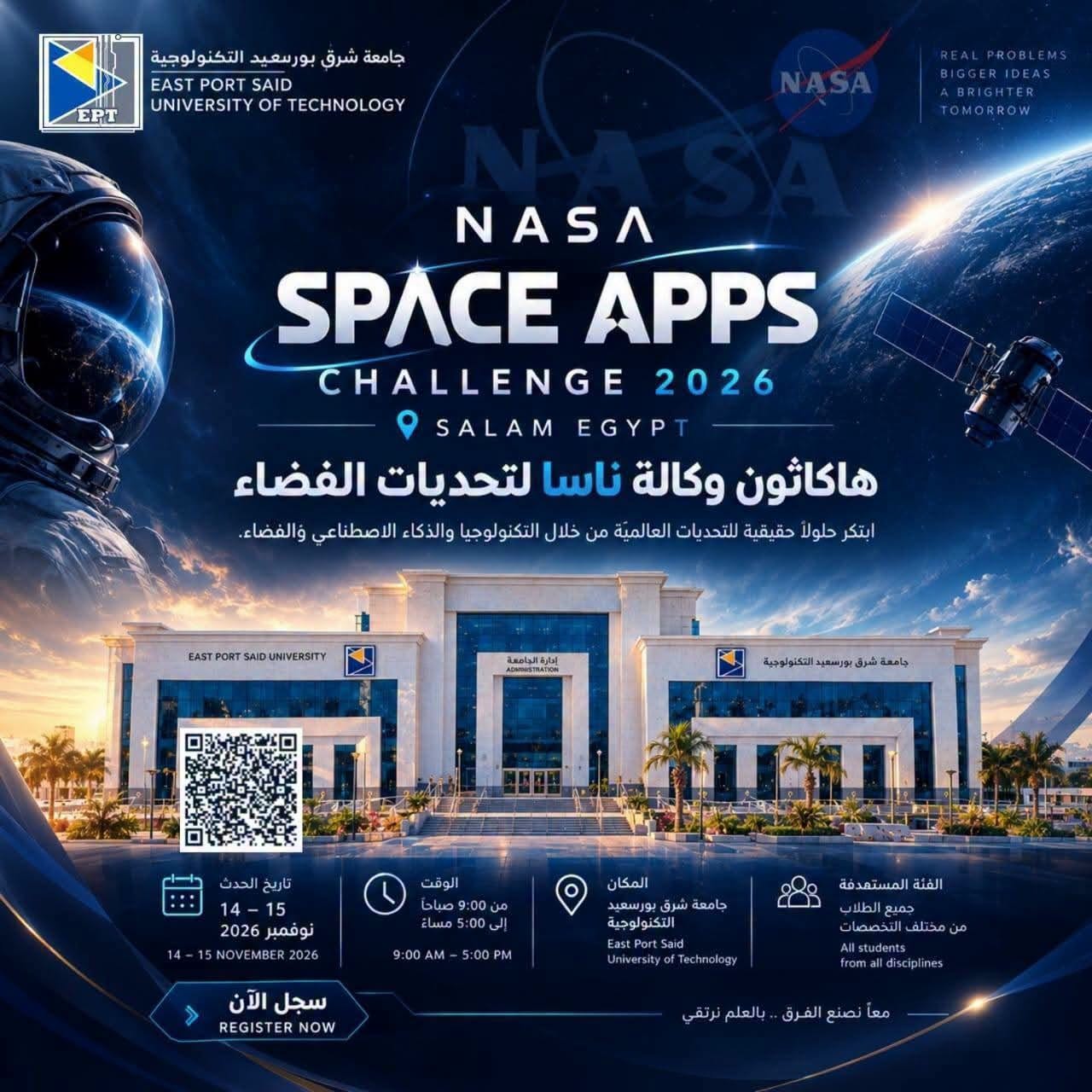
Prof. Dr. Ashraf Heneigal, President of Suez University, has sent a congratulatory message to students of the university’s Faculty of Computers and Information on their outstanding scientific and technological achievement, having secured second place in the NASA Space Apps Challenge – Port Said 2026, competing against 45 participating teams, and qualified for the global stage of the competition.
The University President emphasized that this achievement reflects the outstanding academic standards of Suez University students and their ability to innovate, demonstrate creativity, and employ modern technologies and artificial intelligence to develop practical solutions to global challenges. He also noted that the university attaches great importance to supporting young talents and developing their research and technological skills in line with the Sustainable Development Goals and Egypt’s national vision of building a knowledge- and innovation-based economy.
The University President also extended his appreciation to Prof. Dr. Mohamed Aziz, Dean of the Faculty of Computers and Information; Prof. Dr. Yasser Fouad, Vice Dean for Education and Student Affairs; and Dr. Rasha Youssef, the Faculty’s Student Activities Coordinator.
The competition took place at the Port Said branch of the Arab Academy for Science, Technology and Maritime Transport (AASTMT) from 12 to 14 November 2026, in collaboration with the Information Technology Institute (ITI), the National Telecommunication Institute (NTI), the National Telecom Regulatory Authority (NTRA), and Port Said University. The event was organized as part of broader efforts to promote innovation and technological entrepreneurship among young people.
Suez University was represented in the competition by a team of four second-year students from the Faculty of Computers and Information:
- Karim Ahmed Taha
- Adam Amr Ibrahim
- Ahmed Hany El-Sayed
- Ziad Mohamed Gaber
The team presented an outstanding project entitled **"World Trend Exploration,"** a prototype of an intelligent platform that uses open satellite data provided by the US National Aeronautics and Space Administration (NASA) concerning the African continent. The platform aims to assist researchers, scientists, and specialists in climate and atmospheric data in studying and analyzing climate change patterns over extended periods of up to 30 years.
The project also employs artificial intelligence technologies to predict abnormal climate patterns and phenomena, thereby contributing to early-warning efforts concerning potential risks and natural disasters. The project's innovative approach impressed the judging panel, contributing to the team's achievement of second place and its qualification for the global competition.