 Login


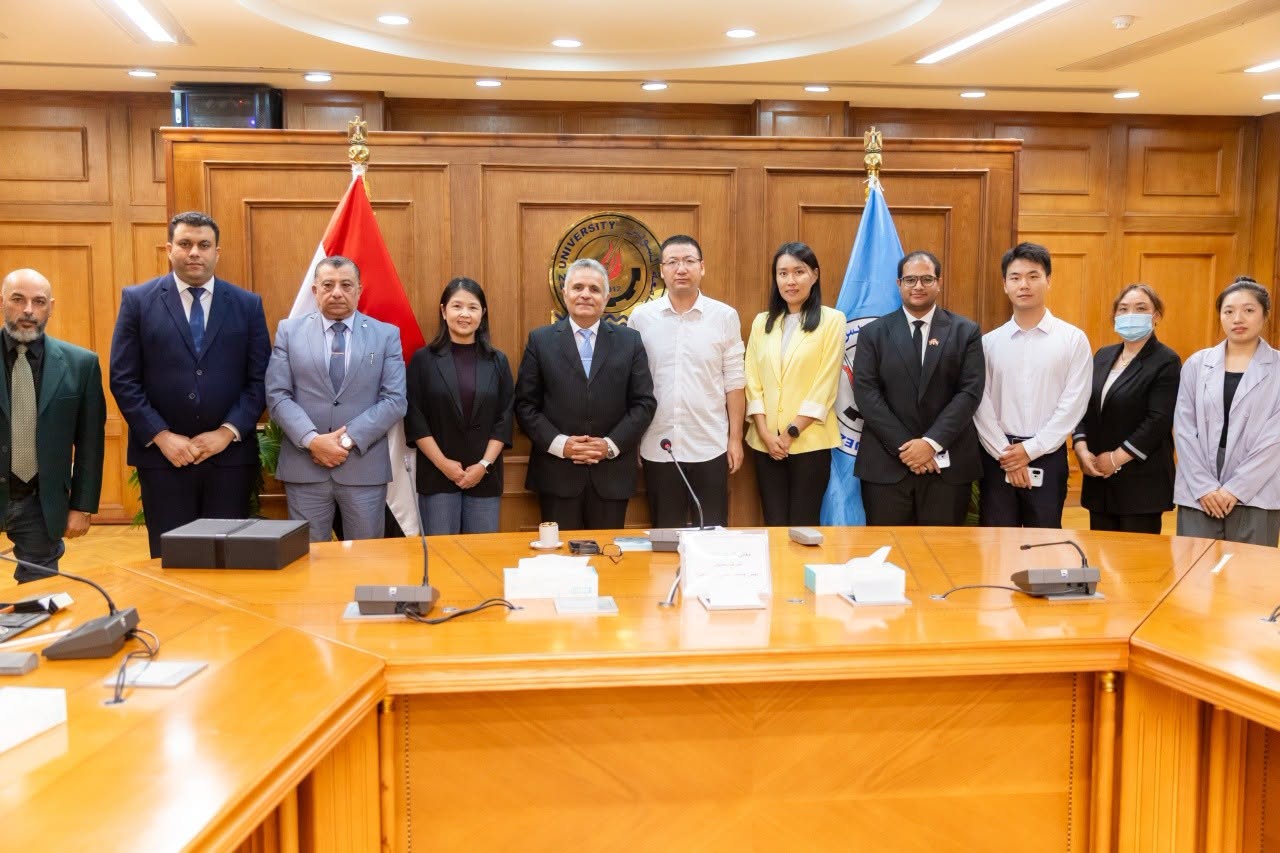
This morning, Prof. Dr. Ashraf Heneigal, President of Suez University, received a delegation from the Chinese CHISAGE Group to discuss prospects for cooperation between the university and the group, in the presence of Prof. Dr. Osama Qadour, Vice President of the University for Community Service and Environmental Development; Prof. Dr. Ibrahim Saad Agwa, Dean of the Faculty of Technology and Education; and Dr. Abdelsalam Malek, Head of the Textile and Spinning Department at the Faculty of Technology and Education.
At the beginning of the meeting, the CHISAGE delegation presented an introductory film and presentation highlighting the group’s establishment, business sectors, industrial capabilities, expertise, and track record. Founded in 1998, the group has more than 5,200 employees and operates in several sectors, including apparel and brands, new energy, new materials, and consumer electronics. The delegation also outlined the group’s plans to establish smart, green, and digitally integrated industrial facilities in Egypt.
A presentation was then given on Suez University, highlighting its academic, research, and training capabilities, as well as the programs and capacities of the Faculty of Technology and Education. Particular attention was given to the faculty’s role in preparing and qualifying technical and technological professionals in line with the needs of industry and the labor market, in addition to its capabilities in apparel manufacturing and solar-panel testing through its internationally accredited laboratories.
The meeting featured extensive discussions on potential areas of cooperation in light of the industrial project that CHISAGE is implementing in the Al-Adabia–Ataqa area of Suez. The project involves establishing an apparel factory expected to provide approximately 5,000 job opportunities, opening broad prospects for cooperation between the group and the university in preparing and qualifying the human resources needed for the project and providing training and employment opportunities for students and graduates.
The discussions covered several proposed areas of cooperation, most notably:
Training and professional development: Implementing specialized training programs in cooperation with the university to develop employees’ skills and enhance their professional competencies.
Field training for students: Providing university students with opportunities for practical and applied training at the group’s workplaces and industrial facilities.
Graduate employment: Cooperating in preparing university graduates and providing them with employment opportunities according to the needs of the new factory, thereby contributing to the preparation of qualified personnel for the project, which is expected to create approximately 5,000 jobs.
Exchange of expertise: Strengthening cooperation between faculty members and the group’s experts in areas of mutual interest.
Scholarships and student support: Exploring the possibility of offering scholarships and supporting outstanding students in ways that enhance their educational and professional development opportunities.
Skills development and training programs: Designing training programs that correspond to the requirements of the apparel industry, technological developments, and labor-market needs.
Research and technical cooperation: Leveraging the university’s laboratory and research capabilities to support the group’s industrial activities and exploring opportunities for cooperation in new energy, materials, and modern technologies.
Both sides emphasized the importance of moving beyond the exchange of ideas toward building a sustainable strategic partnership between the university and industry. Such a partnership would integrate education, training, and employment; support the group’s industrial project; contribute to preparing qualified personnel capable of meeting its needs; and maximize the employment opportunities it will provide in Suez Governorate.
The meeting reflects Suez University’s commitment to strengthening cooperation with major companies and industrial institutions and to connecting its academic, research, and training capabilities with the needs of industry. This approach contributes to qualifying students and graduates, expanding employment opportunities, serving the community, and supporting industrial development in Suez Governorate.