
 Login


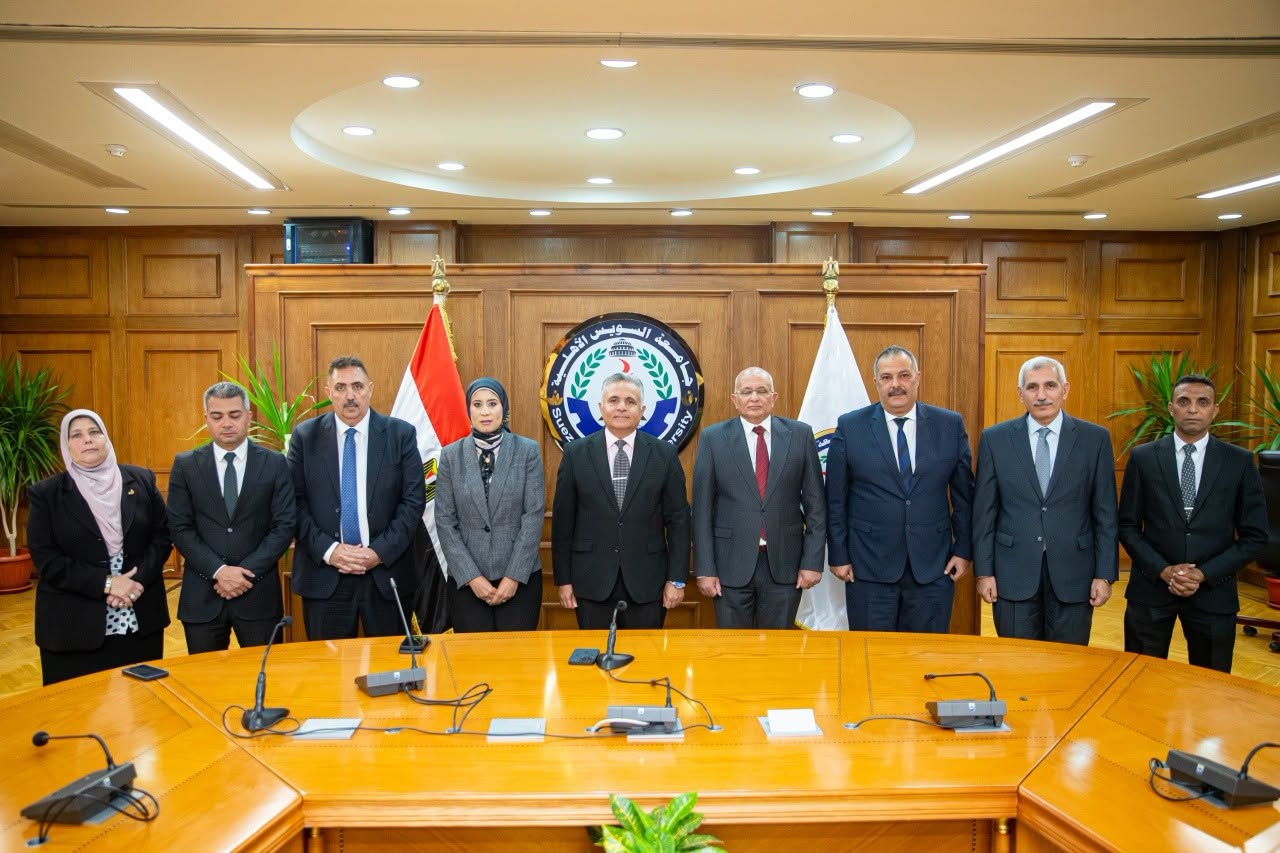
In response to the call of H.E. President Abdel Fattah El-Sisi, President of the Arab Republic of Egypt, to hear the views of academics, experts, and specialists on national priority issues, and in preparation for the launch of Egypt Forum 2026, Suez National University organized extensive discussion and listening sessions on the theme “Development Gaps and Spatial Justice.”
The sessions were attended by Prof. Dr. Ashraf Heneigal, President of Suez National University; Prof. Dr. Ezz El-Din Husseini Gad, Vice President of Suez University for Education and Student Affairs; and:
Eng. Asmaa Ahmed Makhlouf Mohamed, Head of the New Suez City Development Authority.
Major General Hossam El-Din Mostafa, Assistant Minister of Transport for Roads and Bridges.
Eng. Mohamed Ghazal, Vice Chairman of the Egyptian National Railways Authority.
Mr. Mohamed Moatamed, Assistant Minister of Local Development and Environment.
Major General Ahmed Mohamed Ramadan, Chairman and Managing Director of the Drinking Water and Wastewater Company for the Canal Governorates.
Dr. Howaida El-Sayed Mahmoud Hassan, Head of the Central Administration for Project Planning at the Sinai Reconstruction Authority.
Dr. Ahmed El-Desouky, Session Coordinator and Director of Programs at Suez National University.
The sessions also brought together a distinguished group of faculty members, experts, and specialists in the fields of planning, development, economics, and public policy.
These sessions were held as part of the university’s commitment to strengthening national dialogue and drawing on specialized academic perspectives regarding priority development issues. They sought to enrich public discussion of the challenges and opportunities associated with spatial development and to promote balanced development across different regions.
The sessions featured in-depth academic discussions on several key themes, including identifying patterns of spatial disparities and their relationship to services, employment opportunities, internal migration, and urban growth. Participants also examined gaps in the distribution of resources, investments, and opportunities among different regions, in addition to discussing the impact of public investments and national projects on supporting regional development and maximizing the benefits of comparative advantages and local opportunities available across Egypt’s governorates.
The dialogue sessions also addressed indicators for measuring spatial justice, analyzing patterns of development disparities, and examining dimensions related to services, infrastructure, and human development. Participants exchanged academic perspectives on understanding development challenges and their spatial determinants, as well as on approaches to analyzing these challenges from academic and specialized perspectives.
For his part, Prof. Dr. Ashraf Heneigal, President of Suez National University, praised the wise vision of the political leadership and its continued commitment to listening to the views of experts, specialists, and academics across various fields. He emphasized that this approach reflects the state’s belief in the importance of science and knowledge as fundamental pillars for supporting development efforts and shaping the future.
The University President stressed that H.E. the President’s call to hold extensive listening sessions with experts and specialists represents an exemplary model of knowledge-based dialogue and reflects the state’s commitment to benefiting from national expertise and academic knowledge in addressing major development issues that affect the nation’s present and future.
Heneigal also expressed Suez National University’s pride in participating in these national efforts, noting that the university is one of the promising educational projects launched by the Egyptian state to provide modern and advanced university education that keeps pace with global developments and prepares graduates with the knowledge, skills, and competitive capabilities necessary to contribute effectively to the process of comprehensive development and the building of the New Republic.
The discussion and listening sessions concluded in an atmosphere characterized by serious academic dialogue and an exchange of perspectives and expertise among participants on various issues related to “Development Gaps and Spatial Justice.” The sessions formed part of the preparations for Egypt Forum 2026 and reflected the national role of universities in supporting development-oriented thinking and contributing to enriching national discussions on strategic issues.