 Login


(((Source: the official website of the Ministry of Higher Education and Scientific Research)))
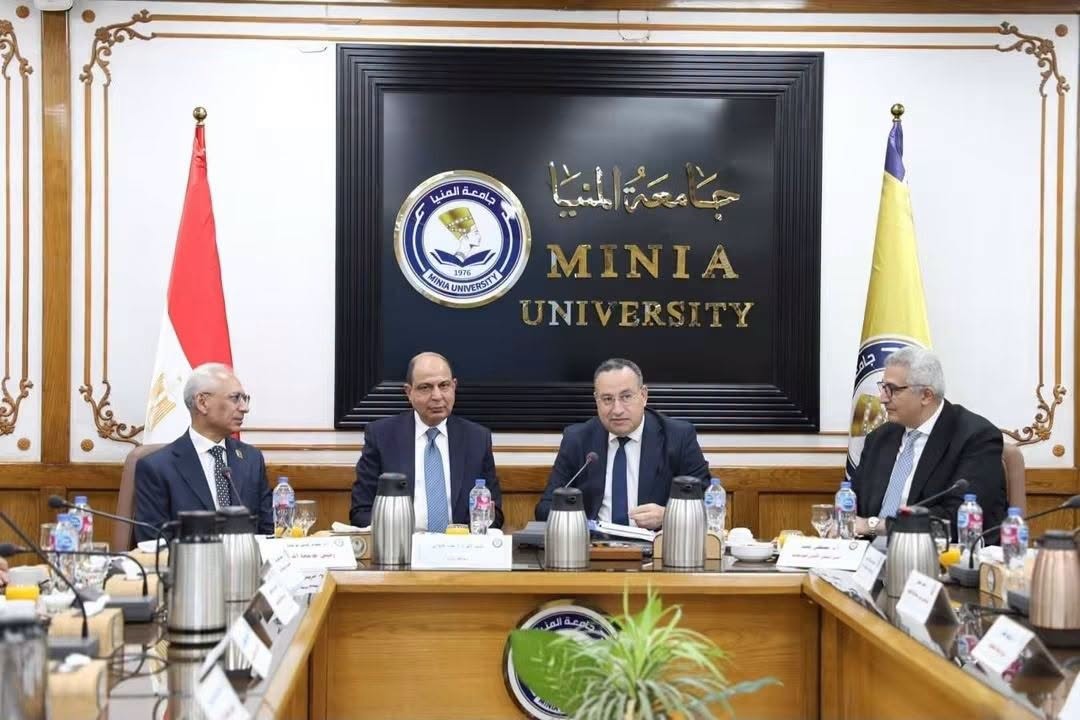
The Minister of Higher Education and Acting Minister of Culture chairs a meeting of the Supreme Council of Universities at Minya University
The Minister of Higher Education has directed that:
- University leadership, teaching staff, associated staff, and the administrative apparatus should work together to ensure a stable and stimulating learning environment for students
- The societal impact of scientific research outputs should be maximized, and serious research projects should be supported.
- To organize student activities and strengthen their role in shaping students’ character and identifying talent.
- To continue efforts to internationalize higher education and expand international academic and research partnerships.
- To enhance the competitiveness of Egyptian universities and support their regional and international presence.
Minister of Higher Education commends:
- The inclusion of 27 Egyptian universities in the 2026 Shanghai Ranking by scientific disciplines
- The inclusion of 47 Egyptian universities in the 2026 UI Green Metric Sustainability Ranking
The Supreme Council of Universities held its regular meeting, chaired by Dr Abdulaziz Qanswa, Minister of Higher Education and Scientific Research and Acting Minister of Culture, in the presence of Dr Mustafa Refaat, Secretary of the Council, and the members of the Council, at the headquarters of Minya University.
The Council expressed its gratitude to the Minya University community, led by Dr Essam Farhat, the university president, for hosting the meeting of the Supreme Council of Universities.
First, Dr Abdulaziz Qanswa emphasized that the Ministry is working to provide a comprehensive system to support innovators and youth, including funding for graduation projects and innovative ideas, technology parks, business accelerators, and start-up incubators, as well as launching initiatives and competitions aimed at transforming ideas into viable models.
Then, the Minister emphasized the importance of upholding discipline and ensuring the smooth running of the educational process across all universities and institutes, as well as the need for university leadership, teaching staff, associated staff, and members of the administrative apparatus to fulfil their duties regularly and to ensure a stable and stimulating learning environment for students.
After that, Dr Abdulaziz Qanswa highlighted the importance of implementing plans for student activities during the new academic year, covering cultural, artistic, sporting, and social areas, as these are an essential part of shaping students’ character, discovering talents, developing abilities, and fostering the values of teamwork and creativity.
Meanwhile, the Minister emphasized the importance of strengthening the role of universities in serving the community and contributing to the achievement of the Sustainable Development Goals, and of linking the education and scientific research they provide to the needs of society and industry, whilst encouraging students to participate in initiatives and training programs that develop their skills and prepare them for the demands of the future. He emphasized that human development is a fundamental pillar in the development of the higher education system, and that the role of the university is not limited to academic objectives, but extends to preparing students who possess the knowledge, skills, and ability to innovate, be creative, and participate positively in society.
Moreover, Dr. Abdulaziz Qanswa emphasized the need to maximize the societal impact of scientific research outputs and to leverage them to support the national economy, noting the importance of supporting and funding serious research projects and providing students and researchers with the opportunity to propose and develop their ideas, thereby contributing to tangible benefits for society.
Hence, the minister emphasized the importance of continuing efforts to internationalize higher education by expanding academic and research partnerships with international universities and institutions, and by expanding joint programs, majors, and dual degrees, as well as student and teaching staff exchanges, thereby enhancing the competitiveness of Egyptian universities, strengthening their presence at the regional and international levels, and contributing to the promotion of Egypt’s status as a regional hub for higher education and scientific research.
Moreover, the minister praised the achievements made in terms of international university rankings, including the inclusion of 27 Egyptian universities in the 2026 Shanghai Ranking of Academic Disciplines. Egyptian universities saw an increase in this year’s edition compared to 2025, with the number of institutions listed rising from 25 to 27, while the total number of entries across scientific disciplines rose from 126 to 135. The number of distinguished scientific fields in which Egyptian universities excelled also increased from 24 to 27. Additionally, 47 Egyptian universities were included in the 2026 UI GreenMetric Sustainability Ranking, 2026. The results showed an increase in the number of listed Egyptian universities from 38 in 2025 to 47 in 2026, adding 9 new universities. The minister emphasized the need for universities to continue supporting researchers to increase scientific publications in prestigious scientific journals, in order to improve the ranking of Egyptian universities in major global rankings.
Also, the Council heard a report on the most notable activities of the Ministry of Higher Education and Scientific Research during September, which began with a meeting between Dr. Mostafa Madbouly, Prime Minister, and Dr. Abdelaziz Qanswa to follow up on the status of private universities regarding their compliance with the requirements for teaching and training hospitals, as well as mechanisms for providing training opportunities to students, thereby ensuring the quality of the educational process and medical training.
Dr. Mostafa Madbouly also held a meeting with Dr. Abdelaziz Qanswa to follow up on the availability of medications and medical supplies in various hospitals—whether university hospitals affiliated with the Ministry of Higher Education and Scientific Research or those affiliated with the Ministry of Health and Population—and to ensure the regularity of their supplies to meet patients’ needs.
In addition, Dr. Mostafa Madbouly opened the 12th African University Games “Cairo 2026,” under the slogan “One Flame… One Continent,” in the presence of Dr. Abdelaziz Qanswa and leaders in higher education. The events accompanying the Games included a diverse program of cultural, artistic, and heritage activities. The minister also attended the launch of the African Scientific Conference on University Sports to review a new strategy for developing university sports and training athletic talent. The minister also attended the closing ceremony of the 12th African University Games, which saw broad and unprecedented continental participation, with 2,082 participants representing 18 countries and 82 universities competing in 18 sports, in addition to 4 Paralympic sports and 3 demonstration sports.
Therefore, Dr. Abdulaziz Qanswa opened the proceedings of the fourth extraordinary session of the General Conference of the Islamic World Organization for Education, Science, and Culture (ISESCO) via videoconference. The Coordination Committee for Youth of Political Parties and Politicians also hosted Dr. Abdulaziz Qanswa to discuss several issues related to the development of the higher education and scientific research system, the retention of academic talent, the development of educational programs, support for student activities, and the promotion of the role of culture in human development. On behalf of the Egyptian Government, Dr. Abdulaziz Qanswa attended the celebrations marking Malaysia’s National Day.
On one hand, Dr. Abdulaziz Qanswa held a meeting with the governor of the Red Sea Governorate to discuss ways to strengthen cooperation between the ministry and the governorate, leverage the scientific and research capabilities and academic expertise of universities and research centers in supporting development and service projects, and contribute to achieving sustainable development in the governorate. The minister also met with the Director-General of the Arab League Educational, Cultural, and Scientific Organization (ALECSO) to discuss ways to strengthen cooperation and address several topics of mutual interest.
On the other hand, the minister participated in the celebrations marking the Egyptian-Japanese partnership in the field of education, the signing of several new agreements, and the expansion of the “Tokatsu” model at Egyptian universities, in addition to the announcement of several initiatives to support students and develop technology education programs and digital skills. In addition, the minister met with the Japanese ambassador to Egypt to discuss ways to strengthen Egyptian-Japanese cooperation in the fields of higher education, scientific research, and technology; follow up on several existing cooperation projects; and explore new prospects for partnership between the two countries.
Nevertheless, the minister participated in an expanded meeting with the ministers of industry and agriculture and land reclamation, as well as the head of the Egypt Future Agency for Sustainable Development, to discuss a proposal to implement an integrated model for the cultivation and processing of flax. The minister also chaired a meeting of the Supreme Council for Technological Education and a meeting of the Board of Directors of the City of Scientific Research and Technological Applications.
As part of his field visits, Dr. Abdelaziz Qanswa toured the Cairo University campus on the first day of classes to assess the university’s readiness for the start of the new academic year, 2026/2027, and to ensure the smooth operation of the educational process. The minister also visited the Alexandria University branch in Borg Al-Arab, which is located on an area of approximately 350 feddans, and toured Borg Al-Arab Technological University to monitor the regularity of classes at the start of the new academic year and ensure the universities’ readiness and the smooth operation of the educational process.
Next, Dr. Abdulaziz Qanswa also visited the Egyptian-Japanese University of Science and Technology (E-JUST) to assess the readiness of the facilities, laboratories, and services provided to students. The minister also visited the campus of Senghor University in Borg al-Arab, Alexandria Governorate, to review the university’s readiness for the new academic year.
Later, Dr. Abdelaziz Qanswa attended the opening ceremony of the national conference “National Identity: Deep-Rooted Traditions and a Renewed Vision,” held under the auspices of President Abdel Fattah El-Sisi at the Bibliotheca Alexandrina. The minister also participated in the first academic session, titled “Characterizing the Current State of Identity Elements in Egypt,” the third academic session titled “Institutions and Policies Shaping Identity,” the third panel discussion titled “Innovation and the Strengthening of National Identity,” and the conference’s closing session.
After that, Dr. Adel Abdel Ghaffar, media advisor and official spokesperson for the ministry, stated that the council followed up on the efforts of the committee formed to develop a comprehensive framework for the initiative to support innovators and talented individuals across all Egyptian higher education institutions in preparation for the launch of the initiative and its implementation by universities.
As a final procedure, the Council reviewed a report presented by Dr. Sherif Khater, President of Mansoura University, which highlighted the best outputs, innovations, and patents at Mansoura University. The report also featured a presentation of the top 25 research projects, with the aim of maximizing the benefits of scientific research, translating it into practical applications and production, maximizing the benefits of the knowledge-based economy, and linking scientific research to industry. The Council also reviewed a report presented by Dr. Nasser Al-Jizawi, President of Benha University. The report covered applicable research and innovation outcomes, efforts to collaborate with industry, and Benha University’s efforts to support scientific research. It included 488 published research papers and 14 innovation projects. Priorities for collaboration with the industrial sector focused on the following areas: water and energy; automation and smart production lines; energy and infrastructure; and smart agriculture and food security.
Also, the Council reviewed a report presented by Dr. Hassan Al-Naamani, President of Sohag University, which detailed the university’s research outputs and the mechanisms for transforming the results of research and scientific studies into applications and solutions that support development efforts for the benefit of society.
In addition, the Council also reviewed a report presented by Dr. Sabrine Abdel-Galeel, President of Luxor University, which highlighted the university’s leading areas of scientific research and the efforts made to strengthen research collaboration with various institutions and entities, thereby contributing to improving the quality of scientific output and increasing the utilization of its results to support the knowledge-based economy.
Moreover, the Council also reviewed a report presented by Dr. Tarek Ali, President of Beni Suef University, which highlighted the university’s best research outputs and mechanisms for maximizing the benefits of scientific research.
The Council also reviewed a report on universities’ efforts to incorporate targets and updates into the University Performance Development Plan, thereby ensuring the governance of higher education institutions—which serve as the cornerstone for advancing the higher education system—and helping them elevate their standing and strengthen their competitiveness at the regional and international levels.
Meanwhile, Dr. Mohamed Sami Abdel-Sadiq, President of Cairo University, presented a report on the university’s performance during the 2025/ 2026, highlighting the university’s most notable achievements, partnerships, and initiatives. This reflects the university’s commitment to enhancing its competitiveness, strengthening the scientific research and innovation ecosystem, supporting digital transformation, encouraging entrepreneurship, and expanding areas of international cooperation, in addition to developing the educational, research, and community services provided to the university’s students and staff.
Finally, Dr. Ahmed Akawi, President of Qena University, also presented a report on the university’s records documenting its comprehensive development process from August 2023 to the present. The university’s efforts have resulted in the completion of 233 development projects across the following key areas: administration and governance; teaching and learning; graduate studies and scientific research; community service and environmental development; quality assurance, accreditation, and institutional excellence; and university hospitals.