 Login


The Minister of Higher Education Directs:
- Strengthening the role of universities in studying the issues, problems, and challenges facing the country
- Improving the efficiency of services provided by university hospitals
- Expand the implementation of automation and digital transformation systems across various university sectors
- Early Preparation for the New Academic Year 2026/2027
- Adhere to occupational health and safety procedures and ensure the security of university facilities
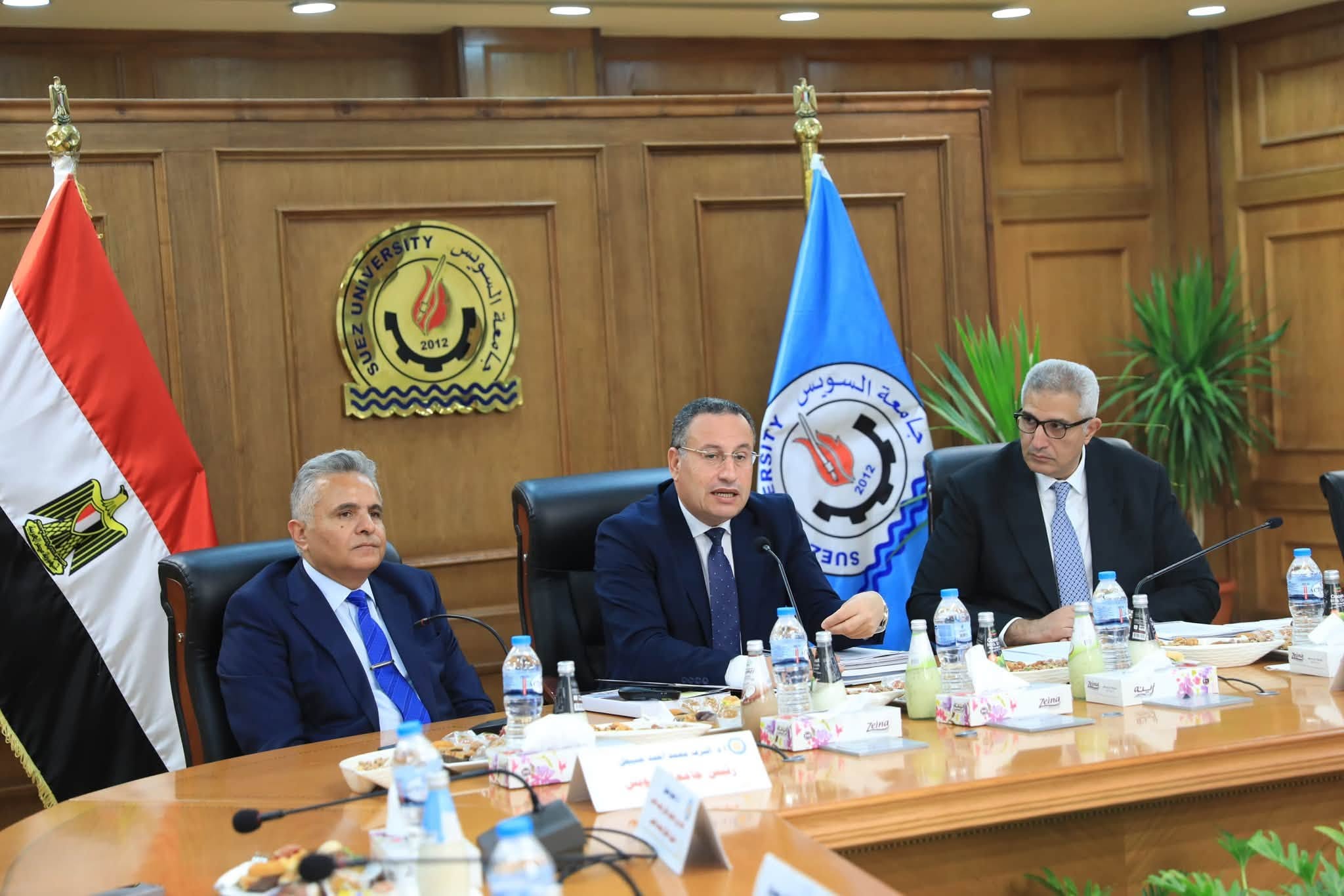
The Supreme Council of Universities held its regular meeting, chaired by Dr. Abdelaziz Qanswa, Minister of Higher Education and Scientific Research and Acting Minister of Culture, in the presence of Dr. Mustafa Refaat, Secretary of the Council, and the Council members, at the headquarters of Suez University.
The Council expressed its gratitude to the Suez University community, led by Dr. Ashraf Hnijal, SU President, for hosting the meeting of the Supreme Council of Universities.
The Council congratulated Dr. Ahmed Abdel-Mawla on assuming the position of Acting President of Assiut University; it also congratulated Dr. Sherif Al-Attar on assuming the position of Acting President of Fayoum University; and it congratulated Dr. Ashraf Imam on assuming the position of Acting President of Aswan University. The Council also congratulated Dr. Mahmoud Siddiq Hassan on assuming the position of Acting President of Al-Azhar University, wishing them all success and guidance in the coming period.
As part of the implementation of President Abdel Fattah El-Sisi’s directives, Dr. Abdelaziz Qanswa directed universities to strengthen their role in studying the issues, problems, and challenges facing the country, and to conduct applied studies and research that contribute to diagnosing these issues and proposing practical, implementable solutions and recommendations, thereby enhancing the contribution of the education and research system to supporting the state’s efforts to achieve sustainable development.
In accordance with the directives of President Abdel Fattah El-Sisi, Dr. Abdelaziz Qanswa universities to continue taking all necessary measures to improve the quality of the educational process, develop academic programs in accordance with the latest international standards, and enhance the efficiency of services provided by university hospitals, thereby ensuring the delivery of outstanding health and educational services that meet citizens’ needs and support the state’s efforts to improve quality of life.
As part of the implementation of President Abdel Fattah El-Sisi’s directives, the minister directed universities to continue expanding the application of automation and digital transformation systems across various university sectors, thereby enhancing the efficiency of university administration, improving the quality of education, and ensuring transparency and objectivity in assessment and examination processes.
Dr. Abdulaziz Qanswa emphasized the need, for the 2026/2027 academic year and as part of preparations for the start of the new academic year, to complete all necessary preparations for welcoming students well in advance and to ensure that facilities, classrooms, laboratories, and lecture halls are ready, to enhance the efficiency of educational and administrative services, and to provide a safe and stimulating university environment conducive to learning, while being fully prepared to welcome both new and returning students and ensuring the smooth operation of the educational process from the very first day of classes, thereby contributing to a stable and orderly academic year and achieving high-quality education.
Dr. Abdelaziz Qanswa emphasized the need for full compliance with occupational health and safety procedures within universities and for providing a safe educational and working environment for students, teaching staff, and employees, stressing the importance of conducting regular maintenance on facilities and ensuring the effectiveness of protective and safety measures.
The minister praised the achievements made in terms of international university rankings, including the inclusion of six Egyptian universities in the latest edition of the Shanghai Ranking (ARWU) for the year 2026, among the top 1,000 universities worldwide, out of a total of more than 2,500 educational institutions evaluated globally. The minister emphasized the need for universities to continue supporting researchers to increase scientific publications in prestigious scientific journals, in order to improve the ranking of Egyptian universities in major global rankings.
The Council heard a report on the most notable activities of the Ministry of Higher Education and Scientific Research during August, foremost among which was a meeting between President Abdel Fattah El-Sisi, the Egyptian President, and Dr. Mostafa Madbouly, Prime Minister, and Dr. Abdelaziz Qanswa to follow up on ongoing preparations for the start of the new academic year at universities and institutes and to ensure the smooth operation of the educational process. The minister reviewed efforts to enhance the educational and research environment, develop educational and training services, improve the capabilities of faculty members, and build their capacities, as well as efforts to transform Egypt into a regional and international hub for higher education, scientific research, and innovation; to strengthen international cooperation and partnerships with prestigious educational institutions; and to align the number of students admitted to university majors with the current and future needs of the labor market.
President Abdel Fattah El-Sisi also held a meeting with Dr. Mostafa Madbouly and Dr. Abdelaziz Qanswa to follow up on the latest developments in the ministry’s work, including the launch of international programs and dual and joint degree programs, as well as efforts to develop and operate university hospitals, as well as reviewing the status of coordinating the admission of high school graduates to Egyptian universities and highlighting preparations for hosting the 12th edition of the African University Games, scheduled to take place in Cairo from September 16 to 8, 2026.
Dr. Mostafa Madbouly held a meeting with Dr. Abdelaziz Qanswa to review the ministry’s key priorities for improving the higher education system. These included enhancing the competitiveness of Egyptian universities, linking scientific research to industry and the knowledge economy, supporting innovation and entrepreneurship, expanding the export of Egyptian education and attracting international students, as well as preparations for the start of the new academic year.
Dr. Mostafa Madbouly also followed up on efforts to develop the system for international students, and Dr. Abdelaziz Qanswa reviewed the operational procedures for improving the system for international students, standardizing admission pathways, and streamlining visa and enrollment procedures for Egyptian universities, in addition to expanding the international marketing of Egyptian higher education.
Dr. Abdulaziz Qanswa signed a cooperation protocol between the Ministries of Higher Education and Scientific Research and the Planning and Economic Development to manage the resources of the Fund for Supporting Innovators, ensuring the optimal return on investment of these resources, supporting innovation, and bolstering plans to develop entrepreneurship in Egypt. In addition, a cooperation protocol was signed between the Ministries of Finance, Higher Education and Scientific Research, and Planning and Economic Development to begin implementing the TIER 1 model for world-class universities in Egypt at five Egyptian universities: Cairo, Ain Shams, Alexandria, Mansoura, and Assiut, in the presence of Dr. Mostafa Madbouly. The minister also met with the top-ranking high school graduates of the 2026 class nationwide, from various academic tracks, as well as the top-ranking students with visual impairments and those in inclusive education programs.
As part of his field visits, the minister inspected the headquarters of the Main Coordination Office at Cairo University to ensure that operations were running smoothly and to provide assistance and facilitate all procedures for students and parents. Dr. Abdel Aziz Qanswa also visited the headquarters of the National Research Center, as well as the headquarters of Al-Alamein International University. The minister also attended Al-Alamein International University’s celebration marking its recognition by the World Health Organization as the first health-promoting university in Egypt and Africa, and attended the graduation ceremony for the first class of the Faculty of Medicine at the Arab Academy for Science, Technology and Maritime Transport.
The report highlighted the minister’s visit to the Republic of Chad, on the sidelines of his participation in the fourth session of the Egyptian-Chadian Joint Committee, attended by ministers, a number of senior officials from both sides, and business leaders. Dr. Abdel Aziz Qanswa also participated in the meeting held with the Chadian president. In addition, the minister conducted an inspection visit to the Alexandria University branch in N’Djamena, Chad, to follow up on the final finishing touches and preparations for the branch in anticipation of its official opening scheduled for May 2027. He also held a consultative meeting with Chad’s Minister of Higher Education, Scientific Research, and Vocational Training to discuss ways to strengthen cooperation between the two sides.
The report added that the minister participated in the plenary session of the seventh edition of the “Egyptians Abroad” conference and met with the Governor of the Central Bank of Egypt to follow up on the latest developments regarding the national initiative to support outstanding students at Egyptian universities, the “Scholars of the Future” scholarship, and to review preparations for the new academic year 2026/2027 and the admission of new students to the scholarship in its second phase, thereby ensuring continued support for socially deserving students and the achievement of the initiative’s objectives. The minister also attended the closing ceremony of the fourth session of the capacity-building initiative for universities in the field of artificial intelligence. He chaired a meeting of the Higher Coordination Committee and held a meeting with the governor of New Valley to discuss ways to strengthen cooperation.
The report added that the first meeting of the boards of trustees of Damanhour Private University and Tanta Private University was held at the minister’s invitation, during which the chair, vice chair, and secretary of the board of trustees were elected at both universities. The minister also signed a cooperation protocol to launch the “Presidential Program for Preparing Egyptian Youth for Leadership,” which aims to identify, nurture, and prepare outstanding Egyptian youth and develop their abilities and skills. The minister also chaired the joint meeting of the boards of private and private-sector universities to announce the minimum requirements. The minister also attended a presentation on the development of university majors for the 2026–2027 academic year at private and community universities and their alignment with the job market. The minister also chaired a meeting of the Board of Directors of the Fulbright Program, the educational and cultural exchange body between the Arab Republic of Egypt and the United States of America, and discussed ways to strengthen joint cooperation with the CEO of Huawei Egypt.
"In 2026, as part of preparations for the Arab Republic of Egypt to host the 12th African University Games in Cairo, a ceremony to light the Games’ torch was held from September 8 to 16 at the headquarters of the Ministry of Higher Education and Scientific Research in the New Capital. The minister also held a meeting with the head of the National Media Authority and the president of the African University Sports Federation to discuss media coverage of the Games. Additionally, the minister received Dr. Ashraf Sobhi, president of the African University Sports Federation, to discuss final preparations and operational arrangements for the Games.
Dr. Adel Abdel Ghaffar, media advisor and official spokesperson for the ministry, stated that the council reviewed a report from the Higher Committee for Aptitude Tests regarding the aptitude tests administered at faculties that require students to pass such tests for admission to the academic year 2026/2027. The report noted a rise in the number of students who registered to take the aptitude tests, reaching a total of 130,474 students, of whom 8,042 were absent, bringing the number of students who actually took the tests to approximately 122,432. Of these, 78,822 students passed, while 43,610 students failed, across all Egyptian universities.
The spokesperson added that the Council has been monitoring the universities’ efforts to implement updates to the University Performance Development Plan, thereby ensuring the governance of higher education institutions as the cornerstone for advancing the higher education system, and to establish a roadmap for completing the development of university performance, thereby helping them elevate their standing and supporting their competitiveness at the regional and international levels.
Dr. Mohamed Hussein, President of Tanta University, presented a report on the university’s plan to expand the reuse of treated water. The report included a technical report on the graywater treatment plant project at the Faculty of Engineering, following its successful completion and commissioning. The report also included an overview of the project’s objectives, the drainage network, the pumping system, the treatment and filtration unit, the reservoir, the control panel, the irrigation network, and the future vision.
Dr. Ahmed Al-Qasid, President of Menoufia University, presented a report on the study approved by the Menoufia University Council and submitted by the Faculty of Engineering’s Department of Architecture, titled: “Thermal Insulation and Design Standards for Achieving Energy Efficiency and Rationalizing Energy Consumption—A Technical Study of Future Buildings,” to establish design standards that can be relied upon in architectural projects to ensure the best thermal performance for new buildings.
Dr. Nasser Al-Jizawi, President of Benha University, presented a report on the university’s achievements in promoting and disseminating a culture of human rights from 2021 to 2026. The report highlighted the university’s efforts to promote the values of citizenship, democracy, and a sense of belonging through academic, awareness-raising, and community activities, as well as the establishment of a Human Rights Unit, the organization of seminars and training programs, the launch of the Benha University Human Rights Award, and efforts to entrench human rights principles within the university community.
Dr. Nasser Al-Jizawi, President of Benha University, also presented a report on the university’s Strategic Plan for Artificial Intelligence—2027–2031—with the aim of establishing an integrated institutional framework for the application of artificial intelligence technologies across various sectors of the university.
Dr. Ahmed Akawi, President of Qena University, also presented a university report detailing the university’s activities during the months of May, June, and July. The report covered the university’s efforts in digital transformation, infrastructure development, the improvement of administrative systems, community service and environmental development, scientific research, innovation, and entrepreneurship, as well as the promotion of opportunities for cooperation.
Dr. Sabrine Abdel-Jalil, President of Luxor University, presented a report on the university’s operational measures to rationalize energy and water consumption through the recycling of graywater, thereby promoting environmental sustainability.
The Council discussed a proposal to sign a cooperation protocol between the regional alliances of Egyptian universities and the National Alliance for Civil Society Development.
The Council also directed that a proposal for an online platform to coordinate universities’ efforts in the “100 Million Trees” initiative be studied.
The Council also discussed the annual report on the activities and events of the Delta Regional Alliance during the 2025–2026 academic year, as part of its support for the presidential initiative “Alliance and Development.”