 Login


Dr Abdulaziz Qanswa:
• Art is an integral partner in personal development.
• Student activities are an integral part of the university experience… and music and the arts open windows to creativity and elevate the spirit.
Dr Ashraf Hnijal: The students’ performances reflected the talents and creative abilities of Egypt’s youth, which are a source of pride… and high art is one of Egypt’s most important soft powers.
Dr Karim Hammam: ‘Tarab’ embodies the state’s belief that discovering and nurturing student talent is a direct investment in the Egyptians.
Maestro Salim Sahab: Talent requires knowledge, training, patience, and discipline to develop into a genuine artistic career.
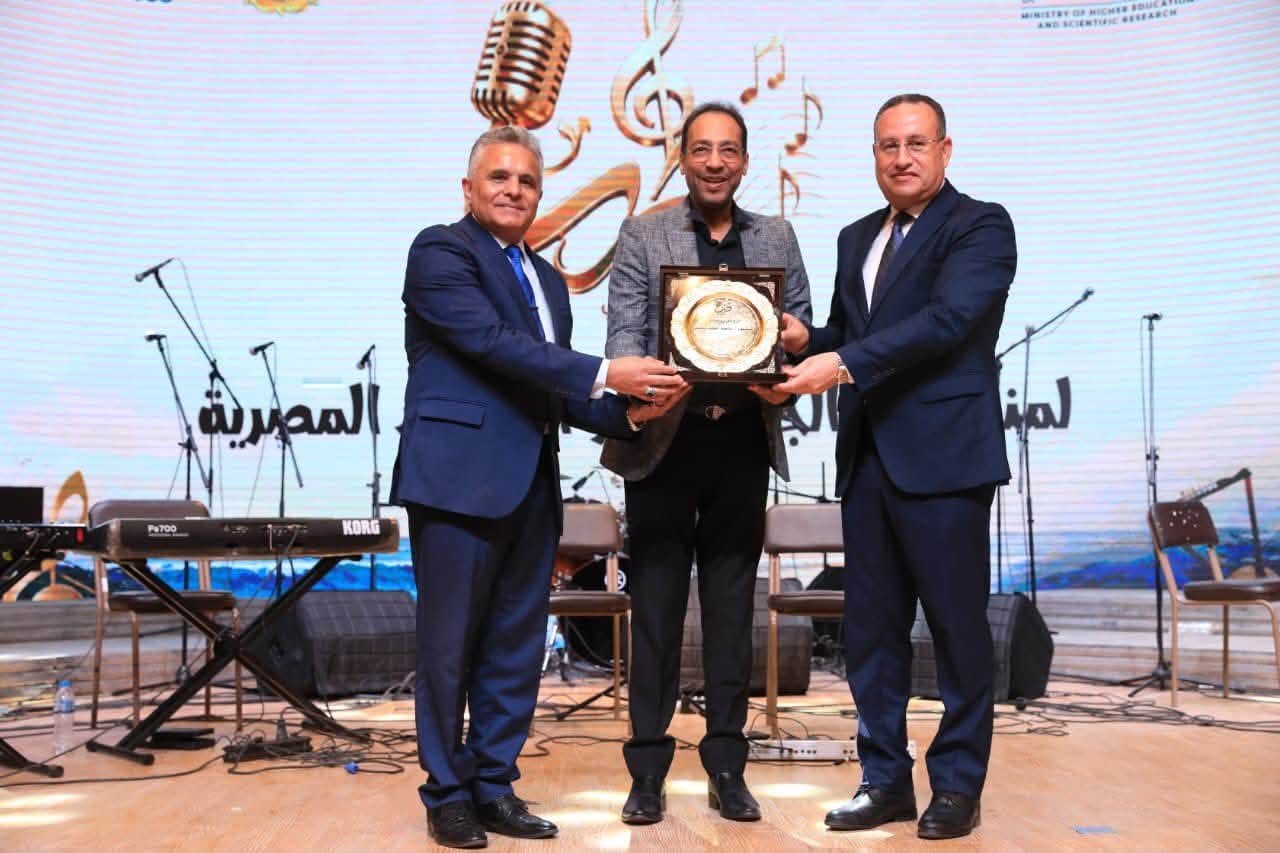
Dr Abdulaziz Qanswa, Minister of Higher Education and Scientific Research and Acting Minister of Culture, attended the closing ceremony of the second season of the ‘Tarab’ Festival of Music and Singing for Egyptian university ensembles, organised by Suez University in collaboration with the Student Activities Sector and the Institute for Leadership Development over a period of five days, with the participation of music and choir ensembles from Egyptian universities and institutes comprising non-specialist students. The event took place in an artistic atmosphere that reflected the richness and diversity of student talent, bringing together the youth from Egyptian universities on a single platform in an experience aimed at discovering talent, honing their abilities, and promoting the values of creativity and teamwork.
The closing ceremony was held in the presence of Dr Ashraf Hnijal, SU President; Dr Karim Hammam, Adviser to the Minister of Higher Education and Scientific Research for Student Activities and Director of the Institute for Leadership Development; and Maestro Salim Sahab; as well as the presidents of Egyptian universities, members of the judging panel, participating students, and delegations from Egyptian universities.
During the closing ceremony, Dr Abdulaziz Qanswa emphasised that the state approaches human development from a holistic perspective, not content merely to provide the tools of knowledge, but also striving to instil awareness, culture, and the capacity for creativity. He pointed out that the youth are not merely the nation’s strength upon which it relies to shape the future, but also the present for which the state works, and the future for which it prepares, with minds that learn, a will to work, and energies capable of creating, innovating, and being creative.
Therefore, the Minister of Higher Education and Scientific Research explained that student activities, in all their various forms, represent an integral part of the university experience, given the opportunities they provide for students to discover their abilities, learn teamwork, take on responsibility, test their competitiveness, and gain the confidence that will help them face life and shape their future, He emphasised that when art enters the university, it does not come as a mere guest to the educational process, but rather as a partner in the development of the individual; for music, singing and the arts elevate the spirit, open windows to creativity, provide young people with a space for expression, and connect them to an authentic aspect of their national identity and history.
Dr Abdulaziz Qanswa addressed a message to the students from Egyptian universities and institutes participating in the festival, calling on them to learn, train, listen and renew their skills, and urging them to make art a message rather than mere noise, fame a result rather than an end in itself, and talent a path through which they can contribute something beautiful to their homeland and to the world.
For his part, Dr Ashraf Hnijal, SU President, emphasised that the outstanding performances showcased at the festival throughout its duration reflected the talents and creative abilities of Egypt’s youth, which are a source of pride and honor. He also noted that what the students presented was not merely an artistic performance, but a sincere expression of promising potential and creative minds capable of innovation and excellence whenever given the right opportunity to showcase their talents.
The SU President explained that high art represents one of Egypt’s most important soft powers, given its role in elevating public taste and human behavior, and in conveying a cultural message capable of influencing and building bridges of communication between peoples. As well, he emphasized that the state attaches great importance to art and culture under the vision of the New Republic, in recognition of their role in building awareness, shaping the Egyptian character, and reinforcing the values of belonging and civic consciousness.
For his part, Dr Karim Hammam, Adviser to the Minister of Higher Education and Scientific Research on Student Activities and Director of the Institute for Leadership Development, emphasised that the ‘Tarab’ in its second season is a true reflection of the state’s belief that discovering and nurturing student talent represents a direct investment in the Egyptian people. In addition, he noted that student activities have become one of the most effective ways of shaping students’ characters, honing their skills and discovering their potential, thereby opening broader horizons for creativity and excellence.
Dr Karim Hammam explained that the festival has succeeded in transforming the university theatre into a genuine space for discovering young artistic talent and has allowed students to showcase their talents before a specialist audience. He emphasised that the Ministry of Higher Education is committed to supporting these talents and providing environments that help them to develop and flourish, thereby contributing to the preparation of a generation of youth who are aware, creative, and capable of competing, and who can carry the message of Egyptian art and culture in a manner befitting Egypt’s status and leadership.
In his speech, Maestro Salim Sahab expressed his delight at taking part in the closing ceremony of the second season of the ‘Tarab’ Festival, emphasising that the festival had succeeded in showcasing young talents with a genuine passion for the arts and a desire to learn and develop. He pointed out that talent alone is not enough, but requires training, knowledge, patience, and discipline to develop into a genuine artistic career.
Moreover, Maestro Salim Sahab urged the students not to view the festival as a milestone that ends with the conclusion of its events, but rather as a new beginning for developing their talents and benefiting from competition and constructive criticism, emphasising that providing opportunities, support, and training for young talent helps to uncover artistic potential capable of achieving greater successes and representing Egypt with honor.
Therefore, Dr Adel Abdel Ghaffar, media adviser and official spokesperson for the Ministry, stated that the festival’s competitions saw a diverse range of student participation across three artistic categories, including group singing, solo singing and solo instrumental performance, enabling participating students to showcase their talents in more than one artistic field, in accordance with specific rules and criteria designed to ensure the fairness of the competition and the quality of the performances. In accordance with the festival regulations, each university participated in group singing with two pieces – one from the folk repertoire and the other a free choice – alongside two students competing in solo singing and two in solo instrumental performance.
The official spokesperson added that the closing ceremony featured several artistic performances that reflected the diversity and unity characterized by the festival, including an artistic ‘medley’ (celebrations from folk tradition) performed by the Cairo University Choir with the participation of students from Egyptian universities, as well as a group song entitled ‘Here is Egypt, Here is My Heart’, performed by students from Egyptian universities under the direction of Maestro Yasser Mostafa, alongside an Egyptian folk medley presented by the Alexandria University Choir, with the participation of students from Egyptian universities under the direction of Dr Shirehan Al-Haddini, in an artistic performance that brought the participants together on a single stage, bringing to a close a journey of competition, training, interaction and the exchange of experiences amongst young people from Egyptian universities and institutes.
The festival’s judging panel comprised a select group of music professors and specialists, namely: Dr Montaser Al-Qalli, Professor of Arabic Music and Head of the Department of Music Education at the Faculty of Specific Education, Assiut University; Dr Dalia Hussein Fahmy, Professor of Arabic Music and Dean of the Faculty of Specific Education, Ain Shams University; Dr Majid Ahmed Mohamed Sorour, lecturer at the Higher Institute of Arabic Music; and Dr Reham Ahmed Ehab, Professor and Head of the Department of Musicology at the Faculty of Specific Education, Zagazig University. The jury assessed the participating talents and performances according to specialized artistic criteria and standards.
The closing ceremony saw the announcement of the results of the second season of the ‘Tarab’ Festival and the honouring of the winners in the various categories, in recognition of their talent and outstanding artistic performances throughout the festival.
In the group singing competition for state universities, the Universities of Asyut, Cairo, and Menoufia took first place, whilst the Universities of Alexandria, Ain Shams, and Suez Canal came second, and the Universities of Suez, Tanta, and Mansoura took third place.
In the group singing competitions for national and private universities, the results were as follows: Badr University in Cairo took first place, Sinai University came second, and Beni Suef Private University came third.
The results of the ‘Public Universities Oscars’ were announced, with Mohamed Gamal, from Tanta University, winning the award for Best Male Singer, and Asmaa Hamada, from Menoufia University, winning the award for Best Female Singer, whilst Kamel Mohamed, from Cairo University, won the award for Best Male Instrumentalist, and Mariam Hani, from Fayoum University, won the award for Best Female Instrumentalist.
The results of the solo singing competition for state universities were as follows, with the top places awarded to: Mark Amjad, Fayoum University; Sosna Tarek, Sohag University; Muhannad Ahmed, Kafr El-Sheikh University; Karim Walid, Port Said University; Aya Hatem, Qena University; Fahd Hamid, Sadat City University; Ahmed Khaled, Capital University; Jofani Nashaat, Assiut University; Hind Ahmed, Ain Shams University; Manah Mahmoud, Alexandria University; whilst the results for second place were as follows: Osama Ibrahim, Zagazig University; Ahmed Hosni, Mansoura University; Rafida Ibrahim, Tanta University; Abdullah Alaa, Suez University; Nour Sayed Mahmoud, Cairo University; Mariam Boulos, Assiut University; Nada Emad, Suez Canal University; Bassam Hassan, Sadat City University; Waad Moussa, Menoufia University; Iyad Ahmed, Alexandria University; and the third-place results were as follows: Sama Abdel-Tawab, Fayoum University; Youssef Saeed, Sohag University; Abdel-Muttalib Al-Sayed, Kafr El-Sheikh University; Shahd Wael, Port Said University; Hussein Mamdouh, Ain Shams University; Noha Mahab, Mansoura University; Jana Ahmed, Zagazig University; Mohamed Ragab, Capital University; Laila Essam, Suez University; and Alaa Ahmed, Cairo University.
The results of the solo performance competition for public universities were announced, and the winners of first place were: Mohamed Ayman, Assiut University; Ahmed Raji, Port Said University; Iyad Ahmed Marai, Suez Canal University; Muhannad Ashour, Ain Shams University; Omar Galal, Tanta University; Hana Mohamed, Alexandria University; and Ahmed Mohamed Al-Dali, Suez University. The second-place winners were as follows: Nada Kamal, Sohag University; Youssef Sadek, Port Said University; Mohamed Khaled, Suez Canal University; Amin Abdel-Qader, Ain Shams University; Mina Sherif, Mansoura University; George Wael, Zagazig University; Mohamed Hani, Menoufia University; and the third-place winners were: Hadi Hisham, Kafr El-Sheikh University; Julie Hani, Mansoura University; Ruslan Ghassan, Zagazig University; and Adham Ehab, Suez University.
The results of the solo singing competition for national and private universities were also announced. The winners of first place were: Ahmed Abdel Aziz, Al-Galala University; Heidi Alaa, Mansoura Community University; Mariam Mohamed, Badr University, Cairo; Ilaria Akram, Sphinx University; and Shihab al-Din Alaa al-Din, Daraya University. The winners of second place were: Ibrahim Mohamed, Sohag National University; Karim Hani, Horus University; Abdullah Khalid, Future University; Ahmed Emad, Sinai University; and Mohamed Gamal, Horus University. The third-place winners were: Adam Emad, Daraya University; Nidal Mohamed, Delta University of Science and Technology; Mariam Masad, Al-Nahda University; and Mazen Mohsen, Badr University, Cairo.
The results for the solo performance category for national and private universities were as follows: first place went to Abadir Hani, Sphinx University, and Ali Abdel Hamid, Badr University, Cairo; second place went to Ahmed Yasser, Mansoura National University; and third place went to Tasnim Mohamed, Mansoura National University.
General Administration of the Media Office and Official Spokesperson