 Login


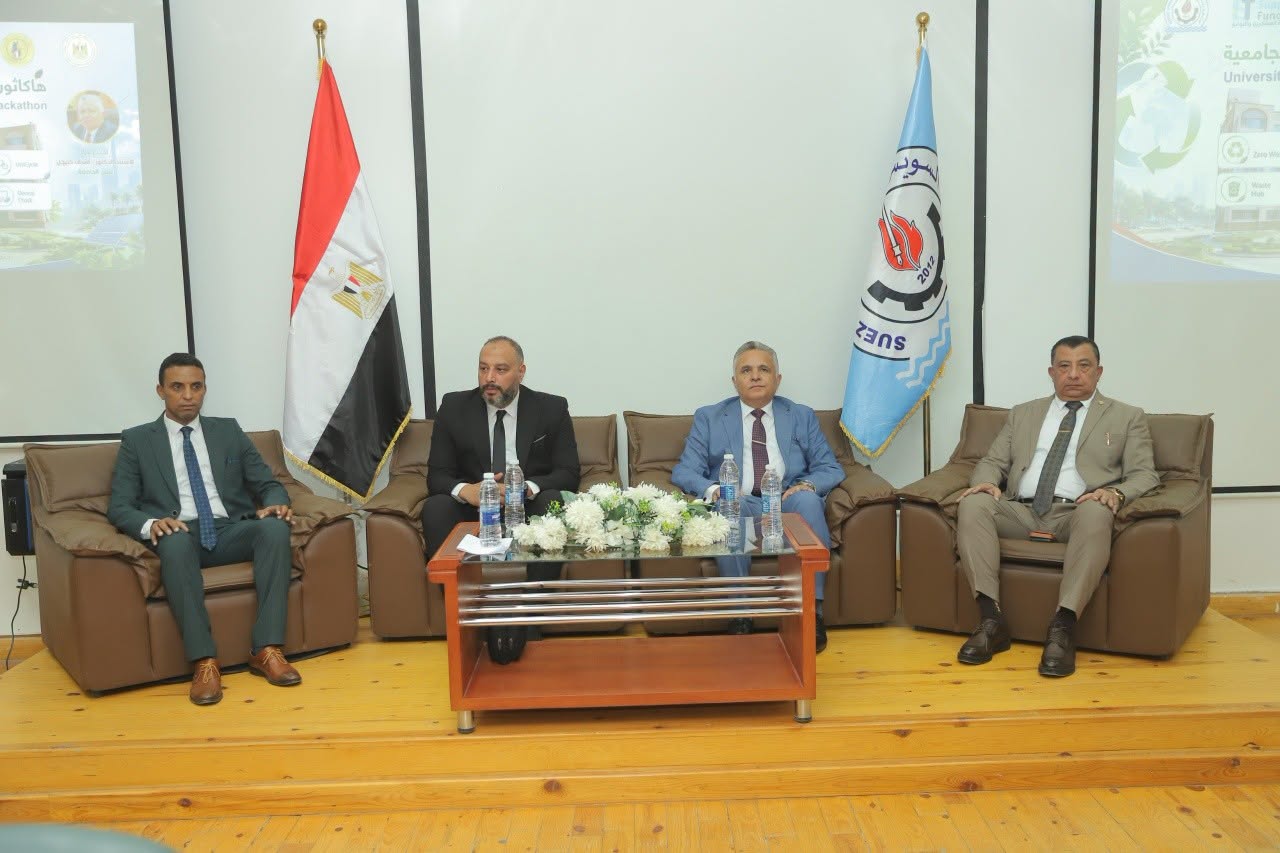
Prof. Dr. Ashraf Heniegal, President of Suez University, witnessed the closing ceremony and announcement of the results of the University Waste Management Projects Hackathon, organized by the University in cooperation with the Innovators and Geniuses Welfare Fund. The event was attended by Prof. Dr. Mostafa Amin Ibrahim, Director of the Innovators and Geniuses Welfare Fund Program and Director of the University Waste Management Program; Prof. Dr. Osama Ahmed Khalil Qadour, Acting Vice President of the University for Community Service and Environmental Development; Prof. Dr. Ezz El-Din Husseini Gad, Vice President of the University for Education and Student Affairs; Prof. Dr. Sherif Mohamed Fahmy, Acting Vice President of the University for Postgraduate Studies and Research; Dr. Ahmed El-Desouky, Hackathon Coordinator; as well as faculty members and participating students.
In his address during the event, Prof. Dr. Ashraf Heniegal welcomed the attendees and expressed his appreciation for the role played by the Innovators and Geniuses Welfare Fund in supporting the innovation and entrepreneurship ecosystem. He also extended a special greeting to Prof. Dr. Tamer Hamouda, Executive Director of the Fund, in recognition of his continuous efforts to support innovators and talented young people at Egyptian universities.
The University President emphasized that the Egyptian state, under the leadership of H.E. President Abdel Fattah El-Sisi, places great importance on innovation and creativity, based on its conviction that young people represent the nation’s true wealth and that their ideas and capabilities constitute a fundamental pillar for achieving sustainable development and building the future. He also highlighted the support and attention given to innovation by the Ministry of Higher Education and Scientific Research, headed by Prof. Dr. Abdel Aziz Konsowa, Minister of Higher Education and Scientific Research, with the aim of empowering young people and transforming their ideas into projects with a tangible impact on society.
Prof. Dr. Heniegal explained that organizing the hackathon reflects Suez University’s commitment to supporting innovative ideas with environmental and societal dimensions and highlighting the importance of recycling university waste. He noted that waste can be transformed from an environmental challenge into a promising opportunity for developing innovative solutions that promote sustainability and enhance environmental awareness among students.
Addressing the participating teams, the University President emphasized that all participants should be considered winners in recognition of the ideas, efforts, and valuable experiences they presented. He pointed out that the ranking of the projects does not diminish the value of any project, but rather represents one step in a broader journey of learning, development, and innovation. He called upon the students to continue developing their ideas and transforming them into viable and applicable prototypes.
For his part, Prof. Dr. Mostafa Amin Ibrahim expressed his appreciation to Suez University and its administration for the substantial support provided to ensure the success of the hackathon. He praised the distinguished quality of the participating projects and commended the University’s students for the enthusiasm and creativity they demonstrated. He further noted that Suez University achieved an outstanding level of participation in terms of the number of projects submitted, ranking second among participating Egyptian universities in terms of the number of competing teams and projects, reflecting the high level of awareness and innovative capabilities of its students.
At the conclusion of the event, the University President honored all participating teams in recognition of their efforts and creativity and announced the three winning projects:
First Place: The Faculty of Technology and Education team, with its project “Sustainable Builders.”
Second Place: The Faculty of Science team, with its project “Biohydrogen Pioneers.”
Third Place: The Faculty of Engineering team, with its project “Waste2Worth.”
Concluding his address, the University President stressed the importance of transforming the winning projects and innovative ideas into practical, implementable applications. He directed the relevant university authorities and officials to explore mechanisms for supporting and further developing these projects and for connecting them with the needs of society and the industrial sector. Such efforts, he emphasized, would contribute to achieving the Sustainable Development Goals and strengthening the University’s role as a driver of innovation and a partner in community service.