 Login


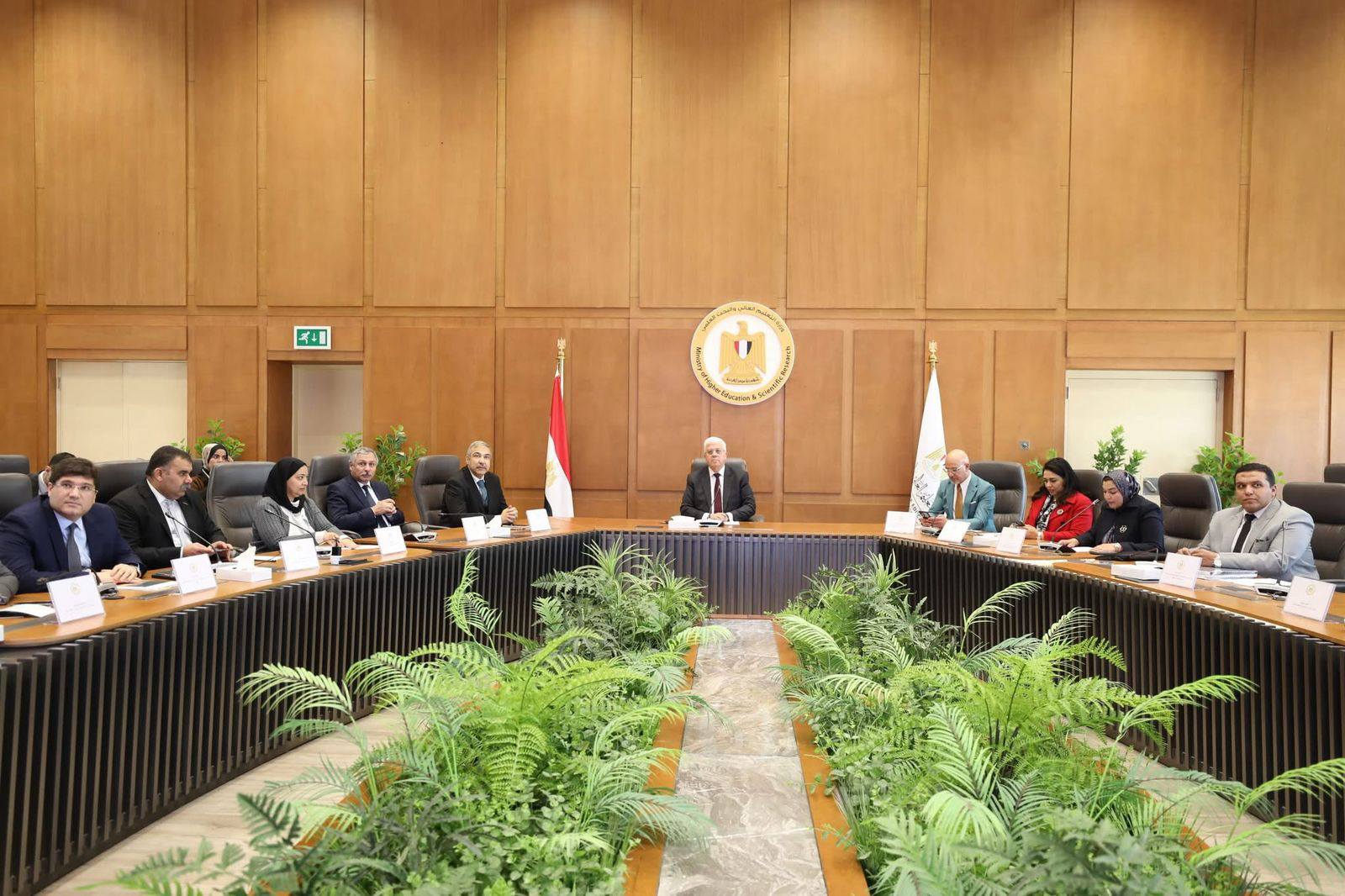
Minister of Higher Education affirms:
* International accreditation sends a clear message reflecting the maturity of the institutional system within the ministry and its ability to adopt innovation as a tool for sustainable development.
* The Ministry's achievement of this global ranking is the beginning of an accelerated shift towards an institutional model based on knowledge and creativity.
* Accreditation is a strategic step towards enhancing the competitiveness of academic and research institutions on the global stage.
* We aim to build a sustainable learning and innovation ecosystem within universities and research centers.
* Continue to encourage researchers and youth to produce knowledge and use it to develop practical solutions that serve society and the state.
* Continue to expand partnerships, strengthen capabilities, and transfer technology and knowledge to support the state's competitiveness.
* The accreditation application file included a presentation of the ministry's plan for managing innovation and the initiatives implemented.
* The launch of the National Strategy for Higher Education and Scientific Research and the National Policy for Sustainable Innovation came at the forefront of the ministry's efforts to support innovation.
We aim to transform from a consumer of knowledge and science to a producer and exporter of knowledge.
The Global Innovation Index (GInI) announced that the Ministry of Higher Education and Scientific Research has been awarded the “Certified Government Innovative Organization” (CGInO) with a five-star rating, the highest international rating in the field of institutional innovation management. This makes the Egyptian Ministry of Higher Education and Scientific Research the first government agency specializing in higher education and scientific research worldwide to obtain this accreditation.
Therefore, Dr. Ayman Ashour, Minister of Higher Education and Scientific Research, emphasized that this international accreditation sends a clear message reflecting the maturity of the institutional system within the ministry and its ability to adopt innovation as a tool for sustainable development. He explained that the ministry's achievement of this prestigious global ranking is not the end of the journey, but rather the beginning of a deeper phase of work to accelerate the transition towards an institutional model based on knowledge and creativity. This will be achieved by building a sustainable learning and innovation system within universities and research centers that enables researchers and young people to produce knowledge and apply it to develop practical solutions that serve society and the state.
In addition, Dr. Ayman Ashour pointed out that this achievement is the culmination of the implementation of the National Strategy for Higher Education and Scientific Research, the Sustainable Innovation Policy (2025), the Strategic Charter for Institutional Innovation (2025), and reinforces the Ministry's approach towards building a sustainable institutional innovation system that promotes excellence and supports the transition to a knowledge-based economy. He noted that the Ministry continues to support evidence-based strategic planning through an advanced digital structure for data management, and monitoring and evaluation systems, and performance indicators that ensure the sustainability of improvement and development.
Furthermore, the minister emphasized that innovation is not a separate activity or a temporary initiative, but rather an integrated, evidence-based government operating model, driven by investment in people and translated into measurable, applicable policies and programs. He noted that work will continue in the coming period to deepen this approach by expanding partnerships, strengthening capabilities, and transferring technology and knowledge, thereby contributing to supporting the country's competitiveness and achieving the goals of Egypt's Vision 2030.
Meanwhile, the minister added that this accreditation is a strategic step aimed at enhancing the competitiveness of academic and research institutions on the global stage and achieving the national vision of transforming into a knowledge-based economy, in line with the National Strategy for Higher Education and Scientific Research 2030, which was launched in March 2023 as part of Egypt's Vision 2030. He pointed to the close and ongoing cooperation with the Islamic World Educational, Scientific and Cultural Organization (ISESCO) on this issue, as a key partner in supporting capacity building and exchange of experiences, through joint programs and strategic projects that contribute to strengthening Egypt's position as a regional center for innovation, education, research, and development.
Then, Dr. Ayman Ashour pointed out that the ministry has taken several steps to obtain institutional accreditation, which came as a culmination of the ministry's efforts to support innovation, including the launch of the National Strategy for Higher Education and Scientific Research, which contributed to the shift towards fourth-generation university models based on education, research, innovation, and community service. In addition to developing an innovative mindset among students and researchers through curricula, activities, and interactive learning methods, aligning academic programs with development priorities and changing labor market needs, as well as strengthening regional alliances between universities and economic sectors. This ensures relevance to development realities, developing a supportive infrastructure for innovation through innovation centers, incubators, and university accelerators, and establishing multilateral cooperation between the government, universities, and the private sector to maximize impact, creating leadership positions focused on innovation, expanding international partnerships to promote knowledge exchange and applied research. As well as launching a national policy for sustainable innovation that defines the general framework for innovation, establishing a clear governance structure, implementing programs and building capacity to enhance innovative skills, spreading awareness of participation in events and initiatives, activating the experimentation and improvement space, applying an incentive system to support participation and motivate innovative contributions, monitoring performance and measuring impact, and assessing innovation maturity.
After that, the minister added that several steps have been taken to obtain institutional accreditation, including holding a workshop on “Assessing Institutional Innovation Maturity” to build capacity and determine the current state of institutional readiness. Then, apply for accreditation to the Global Innovation Institute (GInl) to begin the formal review process. Next, getting ready for the pre-assessment phase to identify gaps by accredited assessors and running a training program for university contact points through the “Be Ready” initiative to ensure institutional alignment at the system level. After that, they got initial accreditation, which included identifying targeted improvement points. The final application file was completed and submitted to the assessors after addressing the gaps and strengthening the readiness elements to obtain final accreditation.
Thus, Dr. Ayman Ashour pointed out that the progress report included a presentation of the ministry's plan for managing innovation at the institutional level, along with monitoring initiatives implemented as part of an ambitious action plan to develop policies, work, and services, thereby further establishing innovation as an institutional approach within the ministry and its affiliated bodies. He highlighted the presidential initiative “Alliance and Development” as a model for initiatives, alliances, and partnerships, and the “Be Ready” initiative as a model for initiatives to achieve social impact, as well as an initiative to promote the efficient use of resources through the establishment of national universities spun off from public universities. In addition to launching initiatives to achieve digital leadership, such as the automation of university hospitals and the electronic testing buildings project at universities, as well as agreements to connect students to the labor market, and training teaching staff, in addition to initiatives to facilitate government procedures such as the launch of the EGAID initiative for international students, and sustainability initiatives such as healthcare projects in university hospitals.
Next, the minister added that the impact of these efforts to transform Egypt from a consumer of knowledge and science to a producer and exporter of knowledge has been measured, with global use of Egyptian research increasing thanks to the open access agreement with Springer Nature. The number of downloads of Egyptian articles published through the agreement during the period 2022-2024 reached about 17 million and 288 thousand times. Egypt contributed to scientific production through 1,037 Egyptian journals (481 in Arabic and 556 in English). It also took several executive measures by linking scientific research to industry, including the electric car rally initiative in Alamein International City, which was held in August 2024 in the presence and honor of Dr. Mostafa Madbouly, Prime Minister. In addition, following up on the completion of the V-Tech project for the transfer of technology for low-speed vehicles, in cooperation between the Academy of Scientific Research and Technology and Matgar Engineering and Trading Company, as well as providing a variety of higher education paths, including public, national, and technological universities, branches of foreign universities, universities with framework and international agreements, and private universities, in addition to institutes.
So, Dr. Ayman Ashour explained that the Ministry of Higher Education and Scientific Research is currently working on advancing a set of institutional files that support the consolidation of innovation as one of the components of government operations. He noted that these files include the institutional innovation governance framework for affiliated entities, universities, and their research centers, as well as the institutional model for managing ideas and initiatives and mechanisms for transforming them into implementable applications. This is in addition to the system for developing innovative leaders and cadres to enhance knowledge-based decision-making, the national framework for open innovation to promote integration between education, research, industry, and society, as well as a system for the transfer and localization of technology and knowledge and linking scientific research outputs to development needs, and a model for supporting and developing the entrepreneurial environment within universities to generate projects of economic and social value. He emphasized that these fields aim to enhance the readiness of higher education and scientific research institutions to lead the knowledge and innovation and support their contribution to achieving sustainable national development.
For her part, Dr. Wiam Mahmoud, Executive Director of the Institutional Innovation Unit, explained that this accreditation is a pivotal step towards establishing innovation as a systematic institutional practice within the ministry and its affiliated bodies. She emphasized that institutional innovation is an integrated approach to managing and developing work, based on analytical thinking, future foresight, improving decision-making mechanisms, and developing sustainable solutions to challenges. She explained that this approach aims to build a flexible organizational environment that continuously learns, embraces new ideas, and improves the quality of services and development impact, thereby enhancing the ministry's role in supporting the knowledge-based economy and achieving sustainable national development.
Nevertheless, Dr. Wiam Mahmoud added that the Institutional Innovation Unit was established as a permanent organizational mechanism aimed at governing the innovation system within the ministry, enhancing institutional capacities to develop ideas and initiatives and transform them into practical applications with a tangible developmental impact, in addition to supporting cooperation between universities, national entities, the private sector, and society, thereby ensuring the integration of knowledge, production, and application cycles.
It is worth noting that Dr. Ayman Ashour announced during the weekly cabinet meeting held yesterday, Wednesday, chaired by Dr. Mostafa Madbouly, that the Ministry of Higher Education and Scientific Research had obtained institutional accreditation for innovation from the Global Innovation Institute (GInI). The ministry was awarded a five-star rating as an “Accredited Innovative Government Organization” based on an assessment of its institutional innovation system in governance, capacity development, idea management, and the promotion of participation and open innovation.
In conclusion, the Global Innovation Institute (GInI) is an independent international accreditation body based in the United States of America and is one of the globally recognized authorities for accrediting individuals and institutions in the fields of innovation and institutional innovation management. The “Certified Innovative Government Organization” certification recognizes organizations that meet the highest standards of performance in the field of innovation, and Ginl certifications are officially recognized in more than 160 countries worldwide.