 Login


Statement issued by the Ministry of Higher Education and Scientific Research:
As part of Egypt's celebrations of the 52nd anniversary of the glorious October victories, and in light of the great attention given by the political leadership to major national projects, especially in the Sinai Peninsula and the Canal cities, the higher education and scientific research sector has received support from the political leadership, which has contributed to the development of this important region under the “New Republic.”
Dr. Ayman Ashour, Minister of Higher Education and Scientific Research, emphasized that the state attaches great importance to the development of the Sinai Peninsula and the Canal cities, with unprecedented support from President Abdel Fattah El-Sisi, where major national and development projects have been implemented. He explained that the state has implemented many projects in the field of higher education in Sinai and the Canal cities, at a total cost of 24 billion pounds, in addition to the ongoing construction of some faculties and the equipping of laboratories and workshops.
Dr. Ayman Ashour highlighted the significant expansion of the Egyptian higher education system in recent years, marked by the establishment of new universities, the opening of branches of foreign universities, and the awarding of dual degrees in collaboration with prestigious international universities. He noted the diversity of the Egyptian higher education system, which encompasses public, private, national, and technological universities, as well as branches of foreign universities, and the variety of educational paths that cater to the evolving needs of the global labor market. He emphasized the ministry's keenness to strengthen academic and research cooperation between educational and research institutions and to support means of communication, thereby opening broader horizons for scientific and academic partnerships that serve the state's priorities and contribute to human capacity building.
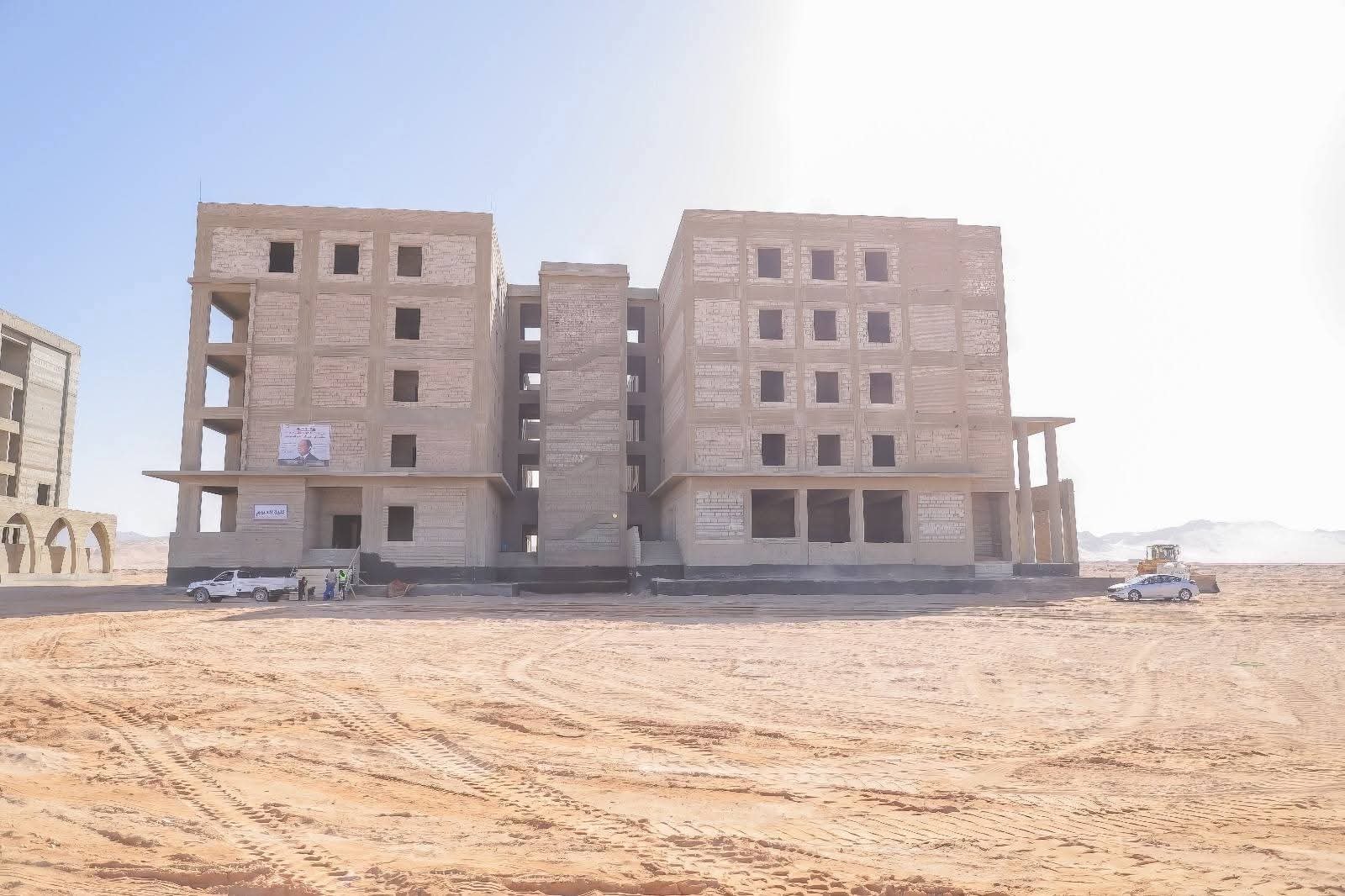
For his part, Dr. Ashraf Hnijal, SU President, pointed out that the first branch of a public university in South Sinai is currently under construction, namely the Suez University branch in Abu Redis, at a cost of approximately EGP 2 billion. The branch will be built on an area of 100 acres and will include 17 faculties and an integrated medical complex. He pointed out that the construction work for the first phase of the faculties is nearing completion, explaining that each faculty building consists of a ground floor and four upper floors.
The SU president added that the next stages of establishing the university branch in South Sinai will include the construction of faculties and lecture halls, university housing, the university administration building, a conference hall, a library, a medical complex, sports city buildings, and an Olympic sports complex that includes playgrounds, a covered hall, and a semi-Olympic swimming pool to serve the people of South Sinai Governorate.
Dr. Adel Abdel Ghaffar, media advisor and official spokesperson for the ministry, stated that the establishment of several universities in the Sinai Peninsula and Canal cities is part of the state's comprehensive vision to support the education system, noting that the establishment of Suez University branch in Abu Rudeis in South Sinai is nearing completion, representing a strong addition to the higher education system in Egypt.
The official spokesperson added that universities encourage the people of Sinai and the Canal cities to continue their university education, spread cultural awareness among them, contribute to the comprehensive development of Sinai and the Canal cities, meet the growing demand for university education, and provide excellent educational opportunities for youth to qualify them to meet the needs of the labor market, in line with the objectives of the national strategy for higher education and scientific research.