 Login


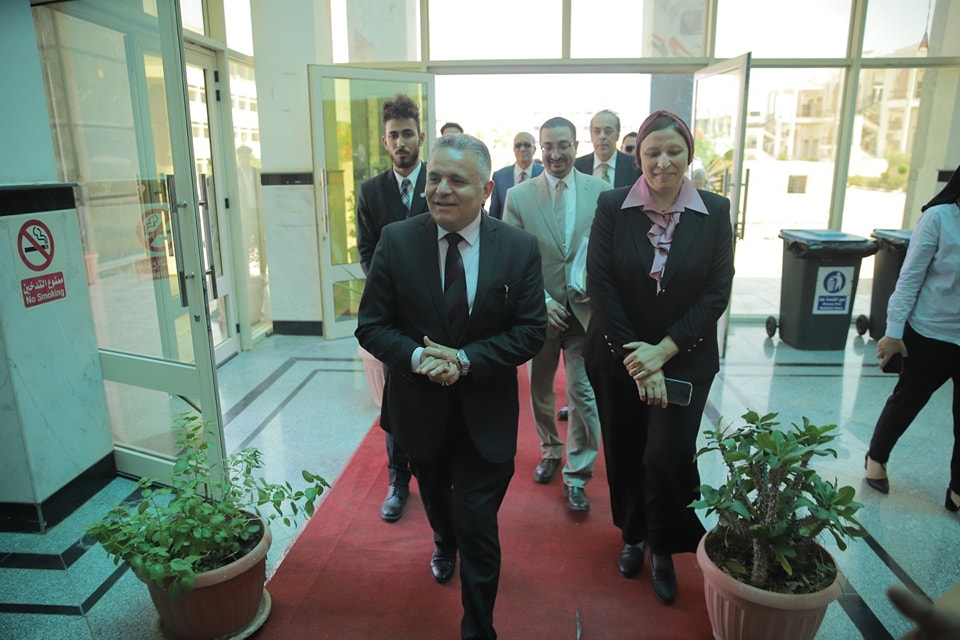
This morning, Prof. Dr. Ashraf Heniegal, President of Suez University, inaugurated the First Student Conference of the Faculty of Politics and Economics under the title “An Analytical Vision of Current Political and Economic Issues and Their Local, Regional, and International Impacts from the Perspective of Young Researchers.” The conference is held under his patronage and was attended by faculty deans, including Prof. Dr. Gamal Salama, the college’s founding and former dean, and was chaired by Prof. Dr. Nibal Ezz El-Din Jamil, Dean of the Faculty. Dr. Ahmed Galal, Vice Dean for Postgraduate Studies and Research, served as the conference coordinator, with participation from faculty members and students.
The conference opened with the national anthem, followed by a video-recorded message from His Excellency Mr. Amr Moussa, former Egyptian Minister of Foreign Affairs and former Secretary-General of the Arab League. In his message, he expressed his pleasure in participating in the conference and highlighted the importance of such events that bring together students and academics to engage in dialogue on pressing global issues. He thanked the organizers and commended the students’ performance and organization, praising the opportunity to speak on the conference themes.
Moussa emphasized the importance of engaging with students of political science and economics, especially in light of the current volatile and ambiguous global conditions. He stressed that this stage demands deep reading and close monitoring of academic research and intellectual contributions from international conferences.
He discussed the multilateral international system, reviewing the UN Charter and the foundations upon which the post-WWII order was established. He posed critical questions: Has this system fulfilled its goals? Has it failed in certain areas? Should it be entirely replaced, reformed, revitalized, or amended?
He clarified that the international system has not failed entirely; rather, it has achieved tangible successes in certain areas, especially through the work of UN-affiliated organizations such as the World Health Organization, the World Intellectual Property Organization, the International Labour Organization, the Food and Agriculture Organization, and UNESCO, all of which play significant roles in supporting developing countries.
He also highlighted the important role of UN funds and programs, including UNICEF (the UN Children’s Fund), which has improved child welfare in the Global South, and the World Food Programme, which has alleviated suffering in poor communities, as well as the UN Development Programme.
The former Secretary-General emphasized that evaluating the international system should not be reduced to a record of failures; instead, it should be viewed comprehensively. He argued that the real failure lies in the global security system.
In his opening speech, the university president paid tribute to Prof. Dr. Gamal Salama, the college’s founding dean, praising the faculty's enduring academic legacy. He emphasized the college’s role as a beacon of critical thinking and future insight, having graduated elite specialists who contribute meaningfully to nation-building and development.
He asserted that Egypt needs mature, conscious youth who understand reality—youth who do not rely solely on the internet and social media. Students of politics and economics, he said, are the intellectual core of this generation.
Heniegal praised the principled and steadfast position of the Egyptian state, as confirmed by President Abdel Fattah El-Sisi, in rejecting any attempts to liquidate the Palestinian cause or undermine the legitimate rights of the Palestinian people.
He extended his salute to the President and reaffirmed full support for all measures taken by the Egyptian state to uphold rights and establish a Palestinian state in accordance with international legitimacy. He described this as essential for achieving lasting, comprehensive, and just peace in the Middle East.
The university president emphasized that the current job market prioritizes skills and experience before academic credentials when it comes to professional selection. He urged all university students to develop and refine their skills through practical experience inside and outside the university, alongside academic study.
He addressed the gap between academic study and labor market demands, advocating for the engagement of academic specialists in the job market to gain experience and update academic capabilities to keep pace with the rapid evolution of job requirements.
The university president also discussed development projects reflecting the Egyptian state’s vision to support higher education and scientific research, including the upcoming opening of Suez National University, which aims to provide innovative academic thought aligned with labor market demands and to foster creativity and innovation.
He also noted the soon-to-open university hospital, which will add quality to the healthcare system by offering excellent medical services to citizens and training medical staff to the highest standards.
Additionally, the new university branch in Abu Rudeis will serve as a scientific beacon for the people of South Sinai, contributing to sustainable development through a modern educational environment that meets community needs and keeps up with global trends.
He referenced the project of Suez Technological University, in collaboration with the Ministry of Petroleum and Mineral Resources, which aims to produce academically qualified graduates able to access job opportunities locally, regionally, and internationally.
Heniegal warned of the dangers of the current open-information era, where information and news spread rapidly, often accompanied by misinformation that undermines trust between citizens and the state.
He called on students to be cautious of suspicious platforms that incite discord and seek to discredit national efforts aimed at achieving stability and prosperity.
He stressed that reason and intellect are our weapons against this media deception. We must look with awareness at the massive number of projects and efforts the state has undertaken in recent years to advance and safeguard the country.
In conclusion, the university president emphasized the need for collective responsibility and called on everyone to consciously resist rumor-mongers who seek only to hinder progress and incite unrest among citizens.
Dean Prof. Dr. Nibal Ezz El-Din welcomed the university president and thanked him for supporting all college activities. She noted that this conference is more than a student event—it is a platform for dialogue, a space for expression, and a venue for nurturing political and economic awareness among the youth.
She stated that the conference brings together a group of promising young minds from the Faculty of Politics and Economics at Suez University—a distinguished institution that produces not just graduates, but future leaders, thinkers, and decision-makers. She emphasized that we meet today at a historic moment, as our Arab region and the world undergo deep and accelerating political and economic transformations. It is the students’ duty to analyze, understand, and propose practical solutions.
Dr. Ahmed Galal, Vice Dean for Postgraduate Studies and Research and the conference coordinator, spoke at the beginning of the conference, emphasizing that student conferences are a vital part of the National Strategy for Higher Education and Scientific Research launched by Minister of Higher Education and Scientific Research, Prof. Dr. Mohamed Ayman Ashour. The outcomes of these conferences positively and directly support the presidential initiative “A New Beginning for Building the Human Being,” by preparing university students to compete in the labor market and strengthening young researchers' ability to face future challenges. Galal also outlined the conference’s schedule and its political and economic sessions.
#Suez_University_Media_Center
#Suez_University