 Login


(((quoted from the official page of the Ministry of Higher Education and Scientific Research))
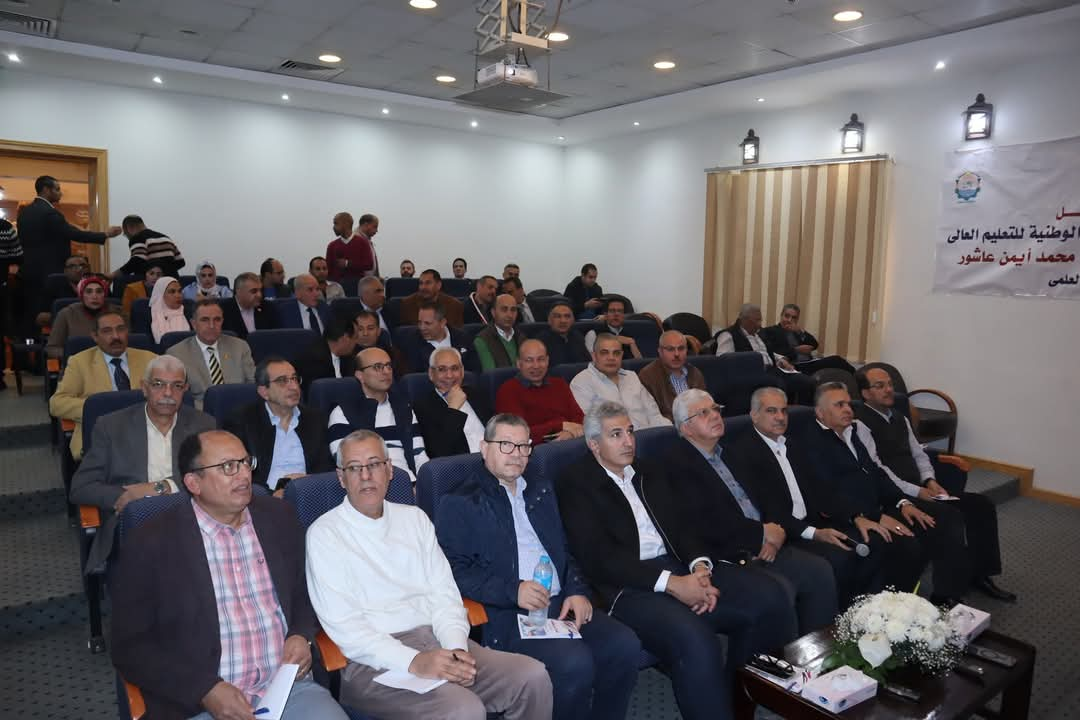
The Minister of Higher Education attends a workshop on "Access to education in the light of the National Strategy for Higher Education and Scientific Research"
Dr. Ayman Ashour, Minister of Higher Education and Scientific Research, witnessed the events of the workshop entitled: "Access to education in the light of the National Strategy for Higher Education and Scientific Research" in the presence of the Secretaries of the Supreme Council of Universities, the Council of Private Universities, the Council of Technological Universities and the Supreme Council of Institutes Affairs, and several university presidents and Ministry leaders.
Dr. Ayman Ashour emphasized that the higher education system is expanding considerably thanks to the enormous support provided by the political leadership to accommodate the increasing demand for university education, noting that population growth requires establishing different universities. He also stressed the importance of universities offering modern interactive courses that meet the requirements of the local, regional, and international labor market as well as contributing to attracting students to attend universities and practically training students in collaboration with various companies to qualify students to be eligible for the labor market to refine students' experiences and develop their abilities and skills, in line with the objectives of the National Strategy for Higher Education and Scientific Research and Egypt’s Vision 2030.
The Minister explained that the higher education system is diverse, comprising government universities, private universities, public universities, technological universities, branches of international universities, and universities with international conventions, frameworks, special laws, and institutes. This diversity helps to improve the system of higher education and scientific research.
Dr. Ayman Ashour noted the importance of continuing partnerships with prestigious international universities to make the most of the development of Egypt's educational and research system, offering distinguished dual-degree study programs, in cooperation with major universities, as well as attracting international students to study at Egyptian universities, supporting the implementation of applied scientific research, co-financing research, in addition to cooperation and integration with various academic, research, and industrial institutions.
Dr. Mustafa Rifaat, Secretary of the Higher Council of Universities, noted a growing demand for students to enroll in modern specializations and study programs that meet the needs of future jobs. In line with the National Strategy for Higher Education and Scientific Research objectives and the achievement of sustainable development goals, study programs are being developed in various colleges. He explained the importance of complementarity between universities and productive and industrial institutions to upgrade graduates' eligibility to compete in the labor market.
Dr. Mustafa Rifaat noted the Egyptian State's efforts over the past period to expand the availability and development of infrastructure for higher education institutions and modernize study programs to adapt to the contemporary and future labor market.
Dr. Cyril Clark, Executive Vice President and Academic Director of the Virginia Tech University of America, presented the University's vision for cross-border cooperation, education availability, university enrolment mechanisms, and scholarship systems. He explained that the university offers many study programs, bachelor’s degrees, and postgraduate and vocational studies are awarded. In addition, it has a highly qualified teaching staff. He also reviewed the most significant challenges that Virginia Tech University has overcome.
Dr. Cyril Clark presented the University's mechanisms and efforts to link study programs with the industry community to achieve complementarity, cooperation, and coherence between the academic and industrial communities. He clarified the University's interest in the transboundary education system, maximizing the promotion of learning and discovery among different disciplines, as well as the interest in creating an educational environment that stimulates creativity, innovation, and excellence. In addition to qualifying students well through the development of modern study programs and providing students with modern science and technology to be able to meet the needs of the international labor market. He looked forward to strengthening cooperation with Egyptian universities and exchanging experiences; to make the most of it.
Dr. Adel Abdelghaffar, Media Adviser and Spokesperson of the Ministry, stated that the workshop opened a discussion between university presidents and higher education leaders. These discussions resulted in the presentation of positive, productive, and supportive ideas for developing Egypt's educational and research system in the future at the level of developing practical skills for university students according to the needs of the labor market.
The spokesperson added that the workshop reviewed the efforts of universities in the availability file in the light of the principles of the national strategy of the Ministry of Higher Education and Scientific Research, which are based on seven key principles (integration, overlapping disciplines, communication, effective participation, sustainability, international reference, and entrepreneurship and innovation), and agreed on the importance of linking education to society's actual needs.
General Directorate of the Media Office and Spokesperson of the Ministry