
 Login


Faculty of Fish Resources
Tuesday | 16 June 2026
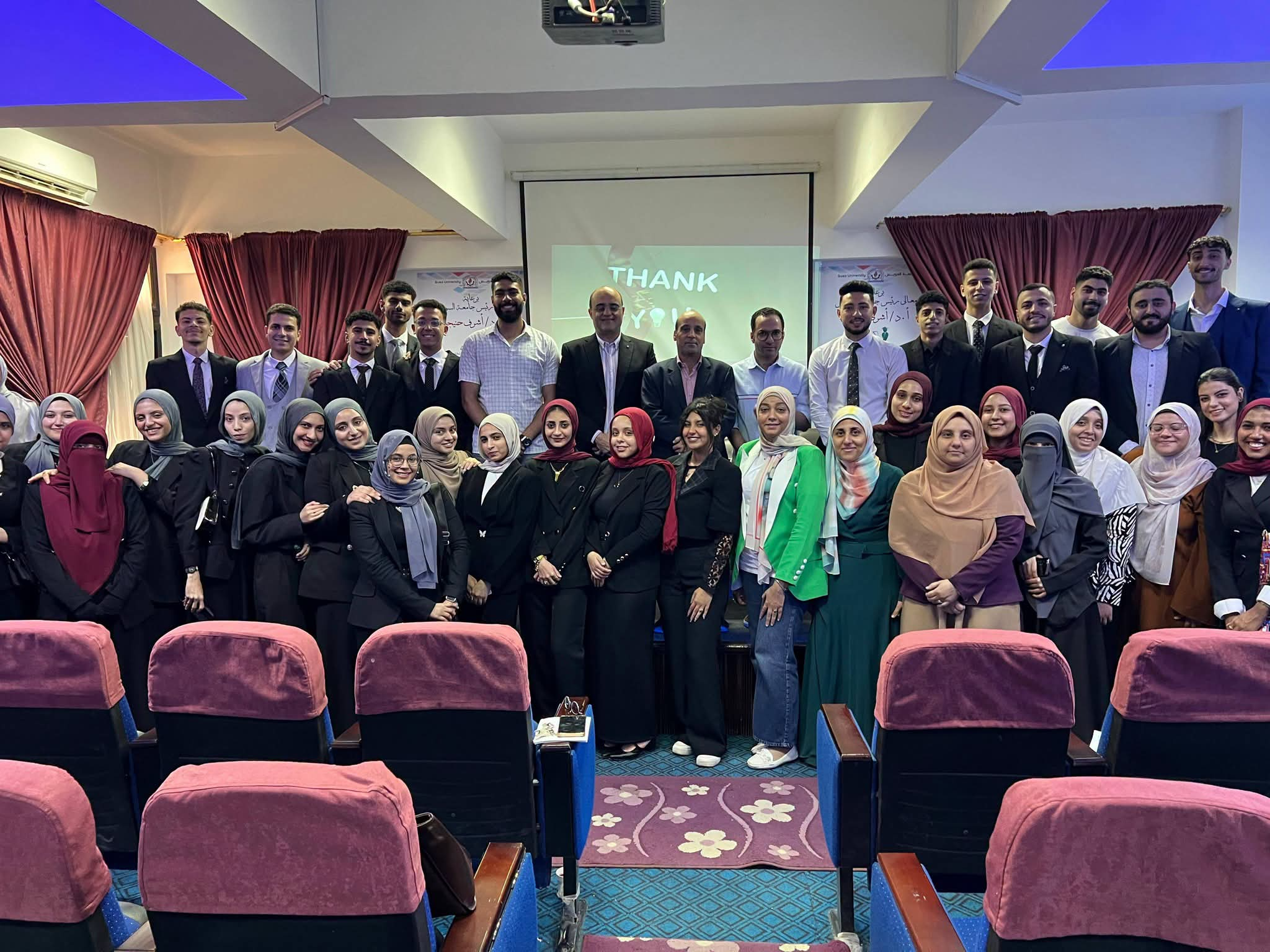
Under the auspices of Prof. Dr. Ashraf Mohamed Hnijal, SU President, under the guidance of Prof. Dr. Ezz El-Din El-Husseini, Vice-President for Education and Student Affairs, and Prof. Dr. Mohamed Saber El-Sabbagh, Dean of the Faculty, and under the general supervision of Prof. Dr. Mohamed Mohamed Saeed – Head of the Department of Aquaculture – and in the presence of the department’s lecturers, Prof. Dr. Shaimaa Mohamed Shalabi and Prof. Dr. Al-Azab Mohamed Tahoun – Vice-Dean of the Faculty for Environmental Affairs and Community Service – students on the Aquaculture Technology program presented their Graduation Projects 1 and 2.
Graduation Project 1 addressed the following topics: -
1- Group led by Assoc. Prof. Hajar Siddiq Daghish
Development of smart, biodegradable bio-film packaging by converting shrimp shell waste into nano-chitosan and combining it with nano-cellulose and natural anthocyanins.
The film possesses antimicrobial properties that delay spoilage and extend the shelf life of products. Furthermore, the anthocyanin acts as a smart indicator that changes colour when seafood spoils due to a change in pH; each colour change represents a different stage of the product’s freshness and degree of spoilage.
2. Group led by Assoc. Prof. Haitham Jamal Abou El-Ela
A comparative evaluation of Tribulus terrestris and 17α-methyltestosterone in the efficiency of sex reversal in Nile tilapia (Oreochromis niloticus).
This study aims to compare the efficacy of Tribulus terrestris, as a natural source of compounds with androgenic effects, and the hormone 17α-methyltestosterone (MT), as the most widely used synthetic hormone, in inducing sexual transformation towards masculinity in Nile tilapia (Oreochromis niloticus). Therefore, the study seeks to evaluate the potential synergistic effect of using both treatments together. The importance of the study stems from the fact that male Nile tilapia is characterized by higher growth rates, better feed conversion efficiency and greater size uniformity compared to females, which has a positive impact on productivity and the economic returns of fish farming.
A total of 3,000 Nile tilapia fingerlings will be used and randomly allocated to four experimental groups: a control group, a group treated with earthworm castings, a group treated with 17α-methyltestosterone, and a group treated with a combination of both substances. The dietary treatments will be administered during the first 28 days of the experiment, after which the fish will be fed a basal diet until the end of the rearing period, which lasts from 75 to 90 days. Production performance will be assessed by measuring weight gain, specific growth rate (SGR) and feed conversion ratio (FCR), whilst sex-conversion efficiency will be determined by analysing the male-to-female ratio and histological examination of the gonads.
The results of the study are expected to help determine the potential for using Tribulus terrestris as a natural alternative to synthetic hormones, as well as to assess the effectiveness of combined treatment in improving the sex ratio and reproductive performance of Nile tilapia under experimental conditions.
3. Group led by Dr. Alaa Saeed Hassan
The effect of phytobiotics on the performance, growth and health of white shrimp (Litopenaeus vannamei)
This project focuses on studying the effect of phytobiotics – bioactive compounds extracted from plants such as herbs, spices, and essential oils – on shrimp feed, to improve growth, increase feed conversion efficiency, boost immunity, survival rates and the total bacterial count in the gut, as well as measuring water quality and the shrimp’s ability to withstand environmental stress. The project concludes that phytobiotics represents a promising and sustainable strategy for improving the productivity of Panami shrimp and achieving more efficient, profitable, and environmentally friendly aquaculture.
4- Group led by Dr. Fatma Zaki Mohamed
IoT-Based Smart Fish Feeding System
IoT-Based Smart Fish Feeding System, utilising technology for the precise calculation and distribution of feed. The system calculates the total daily feed intake based on live weight, then divides this into scheduled meals. A key feature of the system is its ability to calculate the actual amount of feed dispensed from the feeder with high precision. This precision is linked to a smart protection system; the servo motor and the calculation process stop immediately if the dissolved oxygen level falls below 5 mg/l or the temperature rises above a certain threshold to minimise feed wastage and maintain water quality, whilst continuously recording data to ensure the most accurate calculation of the feed conversion ratio (FCR). The feeder is equipped with a switch that activates should the concentration of dissolved oxygen in the water fall below a certain level.
Graduation Project 2, supervised by Dr. Alaa Saeed Hassan. This project focused on the design and operation of an integrated vertical aquaponics system for the highly efficient production of red tilapia and aromatic plants. The project aimed to establish a vertical aquaponics system that combines red tilapia farming with soilless plant cultivation within a closed-loop, environmentally friendly production cycle. The system relies on the recycling of water between the fish tanks and the cultivation units, whereby fish waste is converted into nutrients absorbed by the plants, thereby helping to improve water quality and reduce water consumption.
The system integrates the production of red tilapia and plants into a single, integrated system. This leads to more efficient water use compared to conventional farming, reduces the use of chemical fertilisers and pesticides, improves environmental sustainability and resource reuse, and increases the economic yield per unit area.
The results achieved include improved water quality through the absorption of nutrients by plants, good growth rates for red tilapia and mint, a reduction in water consumption of up to 80–90 per cent compared to conventional farming, and the production of healthy and safe food in a sustainable manner.
Its practical significance lies in supporting food security and providing a sustainable production model that can be applied in areas with limited water resources and limited space; it also represents a promising opportunity for investment in the fields of aquaculture and modern agriculture in Egypt.
Best of luck to our dear students.