
 Login


SU President's word
Suez University is a beacon of education and scientific research in Egypt. The university seeks to achieve the highest quality of education both at the level of higher education and scientific research. Believing that education and ethical morals play a pivotal role in developing the nations, particularly the youth, the university and its scientists attempt to achieve this aim by linking the education and scientific research to the community needs in this crucial stage in the history of Egypt; and this is in the light of President Abdel-Fattah El-Sisi’s discerning vision which places the issue of developing education, scientific research and innovation as a fundamental means for nation’s development and progress.
If science and education embody the mind of the nation, and if the civilizations of nations are measured by the extent of the science and knowledge they achieve and advance in various fields, which achieve positive effects on their society in particular and on the international community in general, then it becomes necessary to have a link between scientific and academic curricula and the goals, aspirations, and challenges facing the nation, whether at the local, regional, or international level. To achieve this, it was necessary to respond to the plan to develop, implement, and establish academic standards that aim to raise the level of quality and development of education and competitiveness at the local, regional, and international levels in a way that serves the process of sustainable development and preserves the nation's identity.
Within the framework of the state's policy and vision to enhance the quality of education in Egypt, Suez University has established a Center for Quality Assurance and Accreditation, aiming to establish the university's quality policy through public awareness of quality assurance policies. Quality will not be achieved unless it is a goal for all of us, as mastery of work is obligatory, as well as credibility in giving data and continuity in achieving quality.
The accreditation of educational institutions is not a goal or an end, but it is considered one of the globally recognized results of the institution reaching the desired level of quality. Accreditation is a recognition by the granting body that the performance of the university in its various faculties, institutes, and departments achieves the mission it has set for itself through its implementation of mechanisms that achieve its strategic goals in the direction of its future vision according to specific criteria.
The National Authority for Quality Assurance and Accreditation of Education (NAQAAE) sets the accreditation standards. The university, with its various institutions, prepares a self-study report. Then, the two parties share the field visit stage to evaluate any of the university's educational institutions. Following this, the authority decides to grant or deny accreditation to the faculty/institute. Since self-evaluation is a key component of quality and accreditation systems, all university educational institutions document their performance by preparing a self-study report that describes, evaluates, and analyzes the performance of the institution in all aspects of work: structure, functions, human, material, and financial capabilities, academic and reference standards, teaching and learning opportunities, scientific research, community participation, professional services, and development management effectiveness. With the help of internal audit and external evaluation, the university and its various educational institutions, including colleges and institutes, through self-study, identify strengths and opportunities to enhance them, as well as weaknesses, challenges, and threats to know how to confront them, and then develop an action plan for development to take advantage of the positives and avoid the negatives.
A key component of quality is an external audit by a team of reviewers affiliated with the National Commission for Quality Assurance and Accreditation (NCQA). When the Commission issues a decision that a university or one of its faculties/institutes has obtained accreditation, this necessarily means that the university continues its development activities to ensure that it retains its recognition, as periodic follow-up by the Commission to the educational institution during the validity period of the accreditation is considered one of the basics of accreditation systems.
Director of the University's Quality Assurance and Accreditation Center
Dr. Muhammad Ismail Fathallah
The Center's Vision
The Center for Quality Assurance and Accreditation at Suez University aspires to achieve leadership in the field of quality assurance and excellence in institutional and academic accreditation at the local, regional, and international levels.
The Center's mission
The Quality Assurance and Accreditation Center at Suez University is committed to continuously developing comprehensive quality assessment mechanisms within the university's administration and its educational, research, and administrative institutions, ensuring the achievement of the university's mission and strategic objectives. This is achieved by applying quality standards and promoting institutional and academic excellence, while fostering a culture of quality throughout the university. It also adopts integrated quality assurance and management systems to improve the quality of education, services, and activities.
-
Preparing university faculties to obtain institutional accreditation and program accreditation, considering the standards of the National Authority for Quality Assurance of Education and Accreditation.
-
Participate in preparing the university's strategic plan with the participation of concerned parties, analyze strengths, improve weaknesses, identify available opportunities, and risks facing the university.
-
Spreading a culture of quality and consolidating the concept of quality assurance and performance evaluation in university institutions among different groups.
-
Cooperation with similar bodies locally, regionally and internationally.
-
Strengthening the university's capabilities and achieving excellence in all fields to qualify it to apply for accreditation by the National Authority for Quality Assurance of Education and Accreditation.
-
Concluding cooperation protocols with the National Authority for Quality Assurance of Education and Accreditation in the field of training to raise the efficiency of all university employees in the field of quality.
-
Qualifying Suez University to obtain an academic accreditation certificate.
-
Involving external civil society bodies and institutions in formulating specifications for graduates of university faculties and institutes.
-
Strengthening cooperation with external civil society institutions and ensuring that they trust the university graduates.
-
Follow up on the implementation of total quality systems within institutions affiliated with Suez University.
-
Coordinating work between all participants in the educational process provided by the university's faculties to ensure academic, research, and administrative quality and to achieve distinguished community service.
-
Preparing university self-study periodically in accordance with the requirements of the National Authority for Quality Assurance and Accreditation of Education.
-
Providing technical support and consultations in the field of quality assurance to all university institutions.
-
Spreading awareness of the culture of quality in the university community among all different groups (teaching staff members and associated staff - administrative staff members - students - graduates - external civil society members- parents).
-
Periodic internal review of university faculties and programs in accordance with the standards of the National Authority for Quality Assurance of Education and Accreditation.
-
Organizing several periodic follow-up and technical support visits to all university institutions to monitor their work and keep up to date with the latest developments regarding quality work.
-
Organizing and implementing training courses, workshops, seminars, and conferences for various groups at the university to develop their capabilities in the field of quality assurance and performance evaluation.
-
Presentation and discussion of quality issues in the University Council.
-
Follow up on the implementation of the university's strategic plan activities related to quality assurance.
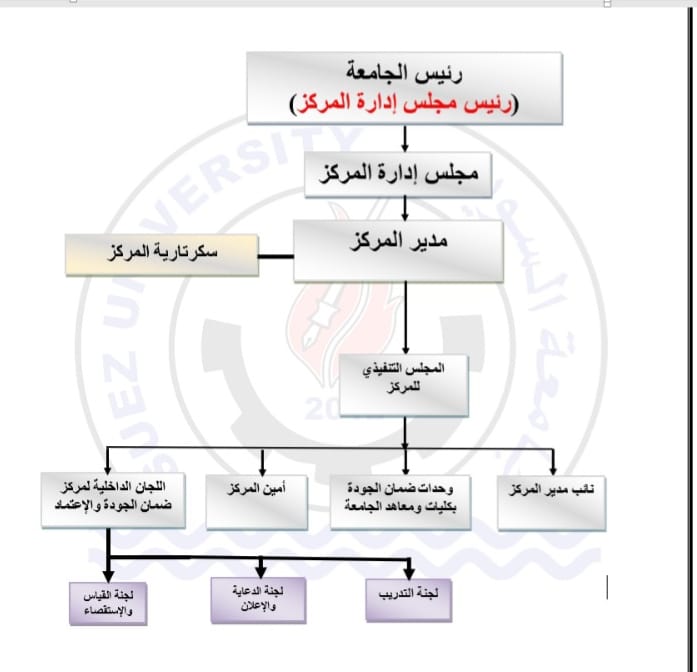
The Center is managed by a Board of Directors as follows:
|
1 |
SU President |
President |
|
2 |
SU Vice President for Education and Student Affairs |
Member (Vice President) |
|
3 |
SU Vice President for Postgraduate Studies and Research Affairs |
Member |
|
4 |
SU Vice President for Community Service and Environment Development |
Member |
|
5 |
Director of Quality Assurance and Accreditation Center |
Member (Secretary of the Board) |
|
6 |
Deputy Director of the Quality Assurance and Accreditation Center |
Member |
|
7 |
2 experts in the field of quality assurance and accreditation (based on the nomination of the center director and with the approval of the SU president, whether from inside or outside the university) |
Members |
|
8 |
2 deans of the university's faculties. They rotate annually |
Members |
|
9 |
Secretary General of the University |
Member |
|
10 |
Secretary of the Quality Assurance and Accreditation Center |
Member |
|
11 |
One of the oldest SU graduates (Appointed by the SU President decision based on the nomination of the Director of the Quality Assurance and Accreditation Center) |
Member |
|
12 |
Secretary General of the University Students Union |
Member |
The SU issues a decision appointing the Center Director from among the teaching staff members at Suez University according to the following criteria:
-
It is preferable to take external review courses for higher education institutions.
-
Previous experience in practicing quality activities at the university, faculty, or institute level (unit management - responsible for a standard... etc).
-
Appropriate academic degree (no less than a lecturer).
-
The appointment decision is for a period of 3 years, renewable once, and the center director must be invited to attend the university council monthly to discuss matters related to quality at the entire university level.
v Competencies of the Centre Director:
The Director of the Centre manages the affairs of the Center and administers its technical affairs within the framework of the policies and decisions of the Board of Directors, and shall in particular:
-
Directing the work of the Centre and following up on the implementation of the decisions of the Board of Directors.
-
Propose the formation and chairmanship of the Centre's Advisory Committee.
-
Prepare the annual plan for the activities of the center and the units in the faculties.
-
Propose rewards and wages for the Centre's employees and those who deal with it, as well as the employees of the quality assurance units in the different faculties and institutes of the university.
-
Preparing the annual report on the activities of the Centre and its units in the faculties and the periodic reports that are submitted on the progress of work.
-
Nominate the heads of the sub-committees of the center, the secretary of the center, the financial officer, and other workers and administrators.
-
Enlisting the help of experts from inside or outside the university to accomplish the tasks assigned to the center and achieve its objectives.
-
Follow up on the activities of the quality assurance units and projects in the faculties and follow up on the implementation of the recommendations and approve the approval of the reports submitted by the unit managers to the University's Quality Assurance and Accreditation Centre, as well as work to promote performance development and continuous improvement.
-
Representing the center in front of others.
-
Work to spread the culture of quality at the university.
v Deputy Director of the Center
The SU President issues a decision to appoint the Deputy Director of the Centre from among the teaching staff members of Suez University based on the nomination of the Director of the Centre, if he is experienced in the field of quality, for a renewable period of one year.
v Terms of reference of the Deputy Director of the Centre:
-
The Deputy Director of the Center manages its affairs and manages its technical affairs within the framework of the policies and decisions of the Board of Directors in the absence of the Director of the Center.
-
Assisting the center director in performing all his duties in addition to other tasks assigned to him by the center director.
Prerogatives of the heads and members of the internal units and committees of the Centre:
-
Follow up on the implementation of the tasks set to achieve the unit/committee's objectives, in line with the Centre's objectives at Suez University.
-
Follow up on the implementation of the decisions issued by the Director of the Centre.
-
Prepare periodic reports and the annual plan for the activities of the unit or committee.
-
(4) internal committees of the Centre (subject to increase by a decision of the Board of Directors based on the proposal of the Director of the Centre).
Tasks of the Centre's internal committees:
(1) Training Committee
- Identifying the training needs of different groups at the university.
- Designing training programs and training plans for different groups at the university.
- Preparing the training schedule (training course/workshop).
- Implementing training according to the announced schedule.
- Measuring the impact and output of training.
- Preparing periodic reports on training and submitting them to the Centre's Board of Directors.
- Printing, approving, and delivering the certificates of trainees and those who attended the training courses or workshops at the center.
(2) Measurement and Survey Committee
- Prepare performance measurement tools and mechanisms for all groups at the university (teaching staff members, associated staff, administrative staff, and students) and carry out performance measurement.
- Prepare standardized forms for different types of questionnaires as well as forms to analyze the results of these questionnaires.
- Prepare the satisfaction measurement report and propose measures to raise satisfaction and submit it to the Director of the Centre.
- Follow up on the implementation of the questionnaire plan in the quality assurance units in the faculties and institutes of the university.
(3) Advertising Committee
- Activating and updating the Centre's Facebook page.
- Creating a YouTube channel that includes all the activities of the Centre's activities.
- Creating a special link for the committee on the official website of the university and updating it continuously.
- Pre-announcing any activities or events (seminars, courses, workshops, conferences, events, etc.) that are planned to be held on a specific date.
- Full media coverage of all activities of the centre (with photography and videography).
- Full coverage of important meetings held by the Centre.
- Announcing any events in which the Centre can participate with full media coverage.
- Developing and updating the Centre's website.
- Prepare the necessary publications to raise awareness of the Centre's topics.
- Spreading the culture of quality at the university by organizing seminars, meetings, conferences, and workshops on quality and its basic concepts.
- Creating standardized forms for all files and documents related to quality.
- Submit a periodic report on the tasks accomplished within the committee to the Director of the Centre.
Targeted activities of the center:
-
Holding introductory seminars on quality assurance, the center’s activities and objectives for teaching staff members, their assistants, administrators, and students at the university.
-
Conducting large-scale reference research using many sources to identify the quality assurance and accreditation systems and mechanisms applied in many countries of the world.
-
Holding several training courses and workshops for faculty members and their assistants at the university in the fields of course descriptions, teaching skills, effective practical training programs, modern teaching methods, group interaction and methods.
-
Organizing several workshops and working groups for teaching staff members and their assistants at the university in the fields of self-assessment strategies, E-Learning skills, decision-making, communication skills, and time management.
-
Preparing a comprehensive description of the courses and study programs of the various faculties and institutes of the university at various stages (bachelor, diploma, master, doctorate) and preparing annual reports on their performance and the needs for their development and support.
-
Prepare a comprehensive periodic report on quality and accreditation within the university.
-
Coordinate and cooperate with relevant educational organizations and institutions in the field of quality assurance and accreditation.
-
Organizing several field visits to educational organizations and institutions concerned with quality assurance and accreditation.
-
Documenting and disseminating quality assurance and accreditation systems in the university and working on their continuity, development, and improvement.
-
Issuing periodic bulletins on the activities and outputs of the center.

Current Headquarters and Contacts of the Center
The center's current headquarters is located on the fourth (upper) floor of the Suez University Administration Building. The center can be contacted through:
Postal address: Cairo-Suez Road, Suez Governorate 8151650
Website: www. suezuni.edu.eg
Facebook Page: Quality Assurance Center - Suez University
E-Mail: info@suezuni.edu.eg
Phone: 062/3523773/3523773
Fax: 062/3523773/3523773